World's First Floating Light Rail: How Engineers Put a 272-Ton Train on Lake Washington
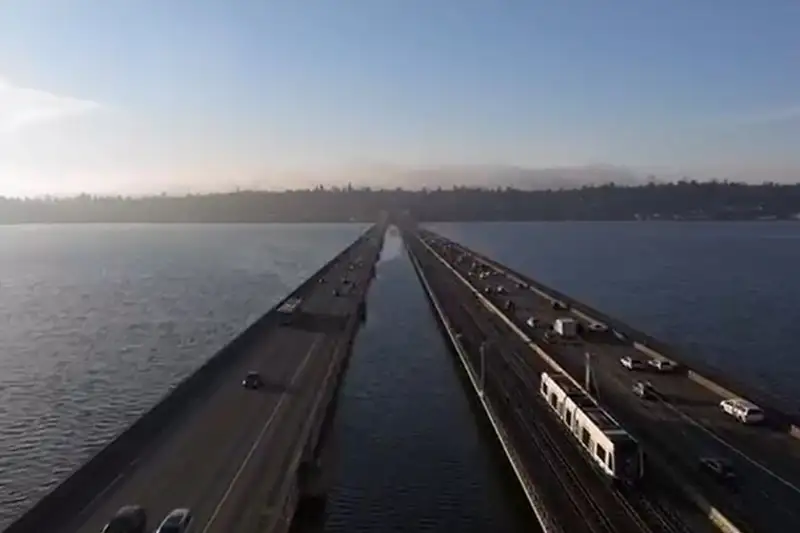
- Sound Transit inaugurated the world's first passenger light rail crossing on a floating pontoon bridge across Lake Washington.
- Engineers resolved dynamic track deflection using advanced flexible rail joints tested with over 10,000 sensors in Colorado.
- An automated dielectric isolation and grounding system prevents high-voltage stray direct current from corroding 38 submerged concrete pontoons.
- The 29-kilometer connection slashes Seattle-to-Bellevue transit times to 25 minutes, fulfilling a 60-year regional planning vision.
Gliding seamlessly across the deep, wind-swept waters of Lake Washington, a four-car light rail train weighing roughly 272 tons has redefined what civil engineering can achieve. The crossing marks the world's first operational passenger railway built directly on top of a floating bridge, connecting the bustling downtown of Seattle with the booming technology epicenters of Bellevue and Redmond.
Quick summary
- Sound Transit launched passenger rail service across the Homer M. Hadley Memorial floating bridge on Interstate 90, marking a global engineering first for floating transit infrastructure.
- Engineers solved critical dynamics problems using specialized track transition joints and conducted full-scale simulations with over 10,000 sensors in Colorado.
- A sophisticated stray-current mitigation system protects 38 hollow concrete pontoons from catastrophic electrochemical corrosion caused by direct current rail power.
- The project realizes a transit vision conceived in the 1960s, slashing commute times across Lake Washington to approximately 25 minutes free of highway congestion.
Why it matters
For decades, natural geographic boundaries have dictated how cities grow, often bottlenecking regional economies when deep waterways split urban cores. The successful deployment of light rail over a floating pontoon structure offers a revolutionary blueprint for coastal and lacustrine metropolitan areas worldwide.

By proving that heavy, electricity-powered mass transit can run reliably on flexible floating infrastructure, transit authorities demonstrate a cost-effective alternative to multi-billion-dollar suspension bridges or deep-bore subaqueous tunnels. For commuters in the Puget Sound region, the line provides immune-to-traffic connectivity between Seattle's commercial core and major tech employers based on the Eastside, transforming regional labor mobility and decarbonizing daily transit corridors.
The Geotechnical Puzzle of Lake Washington
Lake Washington presents an extraordinary geographic obstacle. The lake plunges to depths exceeding 60 meters (nearly 200 feet), but the true hurdle lies underneath: a soft, unstable layer of muddy silt and glacial sediment dozens of meters thick. Driving conventional bridge piers into solid bedrock would require unprecedented depths, making traditional fixed-pier bridges financially and technically prohibitive.
Similarly, tunneling beneath the lakebed posed immense geotechnical risks and astronomical excavation costs. Since the mid-20th century, regional planners solved vehicular crossings by constructing massive floating bridges—concrete pontoons anchored to the lakebed by high-strength underwater steel cables. However, running a high-frequency, heavy electric rail line across a floating structure subject to wave motion, thermal expansion, and changing water levels was considered impossible by conventional rail standards.
Mastering Dynamic Track Movement and Transitions
The primary mechanical challenge for Sound Transit engineers was bridging the gap between solid ground and moving water. While a fixed approach span on land remains completely static, a floating bridge naturally rises, falls, twists, and sways under the influence of wind, lake currents, traffic weight, and seasonal water level adjustments.
If a 272-ton train crossed an unbuffered seam, the acute angular deflections would derail the train or snap the steel tracks. To solve this, specialized track transition joints—often described as curved track bridge joints—were designed to distribute vertical and horizontal deflections across gradual, flexible segments.
Before deploying the system on the bridge, engineers built full-scale track mockups and shipped them to the Transportation Technology Center in Pueblo, Colorado. Rigged with more than 10,000 diagnostic sensors, the test setup subjected the track assemblies and railcars to millions of simulated loading cycles under severe environmental stresses, confirming that the rails could safely absorb continuous multi-axis motion without structural fatigue.
Defeating the Silent Threat: Stray Current Corrosion
Beyond mechanical stress, the engineering team faced a silent, potentially catastrophic hazard: stray current corrosion. Modern light rail vehicles draw high-voltage direct current (DC) from overhead catenary wires and return the electrical loop through the steel running rails. If the tracks are not thoroughly insulated, stray electricity can bleed into the surrounding structure.

In a floating bridge supported by 38 massive hollow concrete pontoons, stray DC current entering the internal steel rebar would trigger rapid electrolysis. This electrochemical reaction can corrode structural steel within concrete at an accelerated rate, causing micro-cracking, water ingress, and ultimately threatening the buoyancy of the pontoons.
To safeguard the decades-old Homer M. Hadley Memorial Bridge, engineers from Universal Technical Resource Services (UTRS) and Sound Transit adopted an uncompromising constraint: zero drilling into the critical pontoon concrete surfaces. Instead, they engineered an advanced dielectric insulation barrier beneath the rail plinths, paired with an automated stray current collection system. Real-time sensors continuously track electrical resistance across the corridor, safely intercepting stray leakage currents and routing them to dedicated terrestrial grounding beds before they ever reach the submerged concrete.
Background
The realization of a rail link across Lake Washington represents the culmination of more than six decades of regional planning and political determination. In the late 1960s, the visionary "Forward Thrust" municipal initiative first proposed building rapid transit to link King County's growing eastern suburbs with Seattle's central district.
Although initial transit funding measures faced political and economic hurdles, forward-thinking planners preserved the corridor's future. In a landmark 1976 multi-agency agreement, regional leaders mandated that when the new Interstate 90 floating bridge was built to replace an older span, its center lanes must be structurally engineered and reserved for future high-capacity mass transit conversion. That foresight paid off decades later when Sound Transit secured voter approval for the Sound Transit 2 expansion program, transforming those central expressway lanes into the newly opened Crosslake Connection.
Qnews24h insight
The completion of the Lake Washington light rail crossing represents more than a regional transit upgrade; it marks a pivotal shift in global infrastructure philosophy. As climate pressures and urbanization force cities to expand across challenging water bodies, building massive suspension bridges or deep-bore tunnels is often hindered by stratospheric capital costs and vulnerable supply chains.
Sound Transit's engineering success demonstrates that retrofitting floating highway assets with multimodal electric rail is both technically viable and operationally durable. However, long-term monitoring remains essential. The true test of this hybrid infrastructure will lie in its operational resilience over the next several decades—specifically how the automated cathodic protection systems and flexible rail joints perform under continuous seismic shifts, severe weather, and daily heavy-load cycles.
Sources
Information in this report is sourced from Sound Transit project documentation, technical engineering briefings from Universal Technical Resource Services (UTRS), and regional infrastructure coverage reported by Soha.vn.
Why it matters
The project proves that modern electrified heavy rail can safely operate over floating structures, establishing a sustainable and cost-effective blueprint for coastal cities with deep waterways while eliminating heavy traffic congestion between major technological hubs.
Background
Dating back to the 1960s 'Forward Thrust' transit proposals, regional leaders ensured via a 1976 accord that the rebuilt I-90 floating bridge would feature convertible center lanes. Decades of planning culminated in Sound Transit's Crosslake Connection project.
The real accomplishment is not merely mechanical adaptation, but the convergence of structural insulation and stray-current engineering. The long-term durability of these automated electrochemical mitigation systems will establish the operational benchmark for floating transit infrastructure worldwide.
References
Editorial information
The editorial team reviews sources, adds context, and structures stories so readers can understand the news more clearly.
Article from QNEWS24H
Comments
(0)No comments yet. Be the first to share your thoughts.