Vietnam Social Security Issues Nationwide Warning Against Impersonation Scams in Public Survey
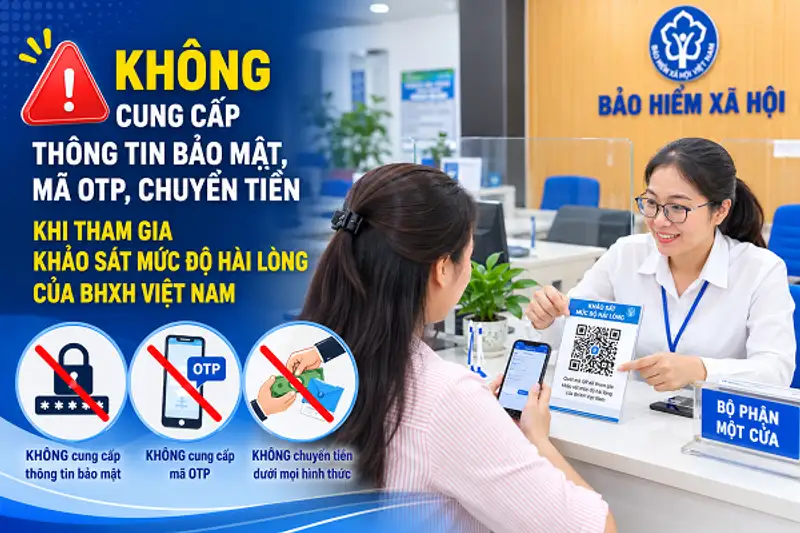
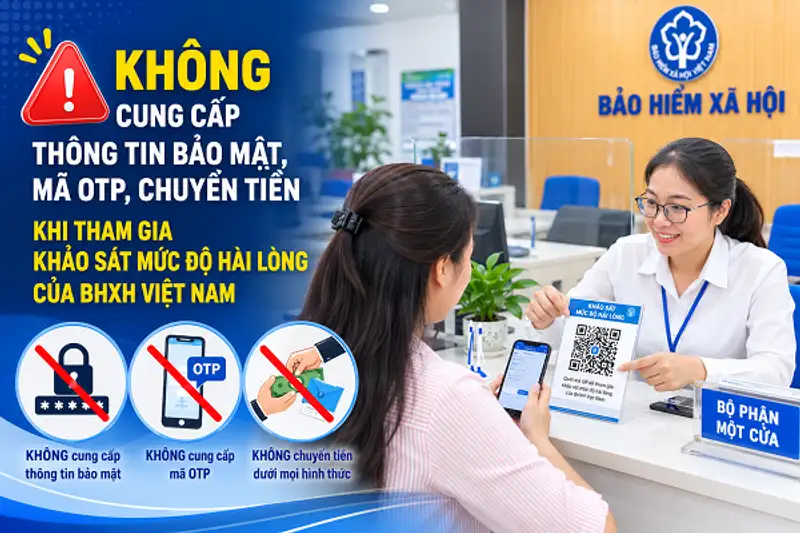
- Vietnam Social Security issued Official Dispatch No. 490/TTHT-KS to launch its 2026 public satisfaction survey across all provincial branches.
- Official participation channels are restricted to verified QR codes at physical counters, the official email tttruyenthong@vss.gov.vn, official social accounts, and 'BHXHVN'...
- The agency confirmed that surveys are completely free and will never request OTP codes, banking credentials, app installations, or wire transfers.
Vietnam Social Security (BHXH Việt Nam) has issued an imperative advisory to citizens, workers, and business enterprises nationwide, establishing clear operational parameters for its annual administrative satisfaction survey while warning the public against rising impersonation scams targeting policyholders.
Quick summary
- Official Dispatch No. 490/TTHT-KS mandates the implementation of the 2026 nationwide satisfaction survey covering social security, health insurance, and unemployment insurance services.
- In-person survey participation is conducted exclusively via official QR codes posted at One-Stop Service counters within local social security offices.
- Digital feedback links are dispatched strictly through the official public domain email tttruyenthong@vss.gov.vn, verified social media accounts, or phone communications displaying the caller ID brandname 'BHXHVN'.
- Vietnam Social Security explicitly confirmed that all survey activities are completely free, prohibiting any requests for fee payments, third-party app installations, OTP disclosures, or financial transactions.
Why it matters
The directive highlights a growing challenge facing public administration across modernizing economies: maintaining open feedback loops with citizens while preventing cybercriminals from exploiting official government outreach. Social security and health insurance benefits touch almost every household and business enterprise in Vietnam. When administrative bodies launch large-scale public engagement campaigns, fraudulent networks frequently mirror these initiatives to deploy deceptive links, extract sensitive financial details, or trick victims into installing malware.
By establishing rigorous, verifiable communication channels prior to data collection, the agency aims to protect citizen financial safety without discouraging public participation. Furthermore, preserving the integrity of the survey process ensures that feedback collected accurately reflects genuine user experiences, enabling policymakers to effectively rectify procedural bottlenecks and administrative delays.
Background
Vietnam Social Security has undertaken broad structural reforms to streamline public administration across its national network. The deployment of single-window service desks—known locally as the One-Stop Service (Bộ phận Một cửa)—alongside digital management portals has accelerated processing times for health insurance (BHYT), social insurance (BHXH), and unemployment benefits. To evaluate the tangible impact of these reforms, the central authority regularly conducts structured assessments across regional branches.
However, the rapid digitization of public services has occurred alongside an increasingly complex threat landscape. In recent years, malicious actors have repeatedly spoofed government channels, sending fraudulent SMS notifications, creating fake mobile applications, or placing fraudulent phone calls claiming to assist with social security updates or emergency benefit disbursements. Recognizing these vulnerabilities, central administrators issued Official Dispatch No. 490/TTHT-KS to establish explicit guidelines for regional offices and inform the public before fraudsters can exploit the survey effort.
Official Channels for Citizen Participation
To ensure total clarity, Vietnam Social Security outlined exact protocol requirements for how citizen feedback will be gathered during the 2026 assessment period. The communication methods differ depending on whether the interaction occurs in person or through remote channels.
In-Person Desk Interactions
For citizens and corporate representatives visiting local social security headquarters or district administrative counters, survey participation is handled entirely through physical display boards. Visitors can scan official QR codes prominently displayed directly at the One-Stop Service counters to access the feedback form on their mobile devices. Administrative staff are instructed never to hand out external storage drives, unverified paper links, or secondary software installation packages.
Digital and Remote Engagements
For individuals who have previously communicated with the agency through digital support nodes—such as the national hotline 1900.9068, official messaging portals, or official email channels—survey invitations are transmitted through strict digital protocols:
- Official Email Domain: Links dispatched via electronic mail will originate exclusively from the official public service address:
tttruyenthong@vss.gov.vn. - Verified Social Media: Digital interactions on platforms like Zalo or Facebook are restricted to official accounts bearing verified government credentials and official verification badges.
- Telephone Outreach: Voice calls regarding survey participation will display the dedicated brandname identity "BHXHVN" rather than unverified personal mobile or landline numbers.
Key Fraud Mitigation and Red Flags
In its notice, Vietnam Social Security emphasized that legitimate survey activities never compromise individual digital security or request sensitive financial data. Citizens are advised to immediately cease interaction if any survey prompt exhibits the following critical red flags:
- Demands for Monetary Payment: The agency explicitly reiterates that participating in government surveys is entirely free of charge. Any request for handling fees or verification deposits indicates fraud.
- Requests for Sensitive Security Information: Official representatives will never ask participants to reveal bank account numbers, credit card details, account passwords, or One-Time Password (OTP) codes.
- Mandatory Application Downloads: Authentic surveys operate through standard web browsers via secure links. Citizens are never required to install custom APK files or third-party mobile software to submit feedback.
- Unverified Link Destinations: Links leading to third-party domains outside the official government infrastructure (such as generic or shortened URL extensions) should be treated as suspicious.
Qnews24h insight
The imperative issued under Official Dispatch No. 490/TTHT-KS underscores a pivotal structural shift in how public institutions manage governance in the digital era. Public satisfaction surveys are crucial tools for institutional accountability, yet without aggressive anti-impersonation safeguards, public outreach initiatives risk inadvertently opening attack vectors against the citizens they aim to serve.
Vietnam Social Security’s proactive reliance on official brandnames and centralized email domains represents a necessary standard for government cybersecurity. However, technical safeguards alone cannot entirely eliminate risk; ongoing public awareness and continuous administrative vigilance remain indispensable. As public institutions continue to digitize critical infrastructure, establishing verified, standardized channels for citizen communication is no longer merely a public relations measure—it is a fundamental component of national cybersecurity defense.
Sources
- Soha News: Bảo hiểm Xã hội Việt Nam có thông báo mới đến tất cả người dân (Reporting on Official Dispatch No. 490/TTHT-KS).
Why it matters
The advisory addresses a critical intersection of public administration and cybersecurity. As government agencies digitize feedback mechanisms, bad actors routinely seize upon public outreach campaigns to execute phishing and credential-harvesting schemes. Establishing explicit verification boundaries protects millions of policyholders from financial loss while safeguarding the integrity of administrative assessment data.
Background
Over recent years, Vietnam Social Security has systematically modernized its administrative ecosystem, transitioning millions of social, health, and unemployment insurance records onto centralized digital networks. However, this expansion has coincided with a surge in sophisticated cyber impersonation tactics targeting social benefit recipients. Similar public outreach drives in the past were targeted by fraudsters posing as state officers to capture personal identity data and bank information.
The proactive warning from Vietnam Social Security reflects a broader imperative for public institutions navigating digital transformation: service accessibility must be counterbalanced by active threat mitigation. While digital surveys offer efficient data collection to refine public policy, public trust remains fragile. Regulators must maintain transparent communication protocols and institutional brandname protection to prevent cybercriminals from weaponizing official government channels against vulnerable populations.
References
Editorial information
The editorial team reviews sources, adds context, and structures stories so readers can understand the news more clearly.
Article from QNEWS24H
Comments
(0)No comments yet. Be the first to share your thoughts.