Satechi ChargeView 240W Review: A Sleek 6-Port Desktop Charger for Power Users

- Satechi ChargeView 240W features six pure USB-C ports with a maximum combined power output of 240W.
- Includes a smart real-time display that tracks port power levels and automatically turns off after one minute to prevent desk glare.
- Priced at $150 with a versatile stand that supports both vertical and horizontal desktop positioning.
Modern desk setups frequently suffer from a persistent operational headache: an endless cluster of bulky power bricks, tangled extension cables, and mismatched wall warts competing for power strip space. As high-performance laptops, tablets, and mobile devices increase their wattage requirements, finding a single unified station capable of delivering high output without turning into an unappealing desk block has remained difficult. Satechi addresses this exact problem with the ChargeView 240W, a dedicated six-port desktop charger designed to replace traditional power adapters while providing clear, real-time power diagnostics.
Quick summary
- Delivers up to 240W of combined power across six pure USB-C ports arranged into three distinct performance pairs.
- Features an integrated real-time power display that automatically powers off after one minute to prevent visual clutter and desk distraction.
- Incorporates modern Power Delivery 3.2 protocols with Adjustable Voltage Supply (AVS) and Programmable Power Supply (PPS) support.
- Retails at $150 with an included multi-position stand supporting both vertical and horizontal desktop arrangements.
Why it matters
As technology ecosystems complete the migration to USB-C as a single universal connectivity and charging standard, legacy power distribution methods are rapidly falling out of favor. Multi-device workers often need to charge two laptops alongside phones, wireless earbuds, and camera equipment simultaneously. Without intelligent wattage allocation, doing so usually requires multiple wall chargers or massive, industrial-looking power hubs that generate significant heat and take up valuable physical desk space.
Furthermore, diagnostic transparency in charging hardware has become essential for power users. Because worn cables or mismatched power standards can silently degrade charging speeds down to trickle levels, having an active wattage read-out allows users to instantly spot bottlenecked ports or faulty cords. Satechi's implementation combines this analytical utility with automated screen dimming, bridging the gap between technical monitoring and clean workspace aesthetics.
Background
Desktop power technology has undergone a multi-phase transformation over the past decade. Early multi-port chargers relied heavily on low-wattage USB-A ports capable of pushing only 5W to 12W per slot. As USB Power Delivery (USB-PD) matured, manufacturers moved toward Gallium Nitride (GaN) components, allowing higher energy density in smaller chassis designs.
Satechi previously established its desktop monitoring concept with the smaller 4-port ChargeView 140W model. While that unit served lightweight mobile setups well, power users driving flagship workstation laptops demanded higher aggregate outputs and additional ports. Competitors like Ugreen and Anker introduced multi-hundred-watt stations like the Nexode 500W and Anker Prime lines, but these often prioritized massive industrial footprints or retained legacy USB-A ports at the expense of pure USB-C versatility.
Designing for modern desk ergonomics
The physical design of high-output chargers often forces a compromise between cooling efficiency and visual appeal. High-power units regularly resemble gray industrial blocks designed for server racks or workshop tables rather than executive desks. The ChargeView 240W breaks from this trend by using a refined, modern housing that blends seamlessly into minimalist office environments.
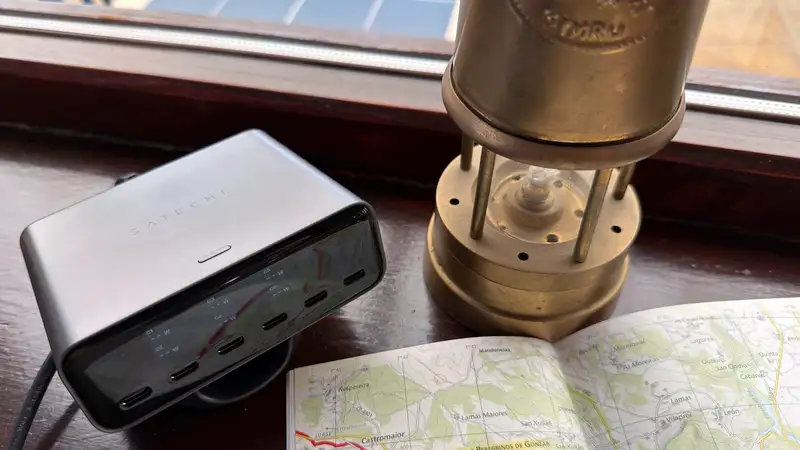
A standing feature of the unit is its dual-orientation mounting system. Accompanied by a dedicated desktop stand, the charger functions stably whether placed lying flat or mounted vertically. A physical toggle button positioned on top of the chassis flips the orientation of the digital display to match the physical placement. Choosing a physical button over capacitive touch controls prevents accidental triggers while adjusting cables.
The built-in display provides clear readouts showing either individual port power delivery or cumulative real-time wattage. To prevent the screen from becoming a constant visual distraction in low-light rooms, Satechi engineered the display to automatically enter sleep mode after 60 seconds of inactivity. Plugging in a new cable or pressing the physical control instantly wakes the screen to display updated power metrics.
Power architecture and dynamic allocation
The ChargeView 240W eliminates legacy USB-A connectors entirely, equipping all six positions with USB-C interfaces organized into three dual-port banks:
- Ports 1 & 2: Up to 140W maximum output per port, supporting Power Delivery 3.2 alongside AVS and PPS protocols.
- Ports 3 & 4: Up to 100W maximum output per port, supporting Power Delivery 3.0 and PPS.
- Ports 5 & 6: Up to 30W maximum output per port, ideal for smartphones, handheld accessories, and compact gadgets.
When multiple high-draw devices are connected simultaneously, the charger intelligently redistributes wattage up to its total 240W threshold. For instance, a user can simultaneously power a high-end workstation laptop at 140W alongside a secondary laptop at 100W. If all six ports are active at once, power is dynamically divided—supplying up to 70W each to the first pair, 30W each to the middle pair, and 20W each to the lower pair.
While 70W represents a reduced peak for top-tier 16-inch laptops, it remains more than sufficient to operate and steadily charge most professional notebooks during active daily use.
Thermal management and safety protocols
Managing up to 240W of throughput in a compact desktop enclosure requires sophisticated thermal dissipation. High temperatures can shorten component lifespans and present safety risks if left unchecked. Satechi integrated three automated hardware thermal modes into the ChargeView 240W that proactively step down charging outputs if internal temperature thresholds are breached during heavy continuous loads.
Users should note that standard power renegotiation occurs whenever a new device is connected or disconnected. The brief 2-to-3 second pause in power output across active ports is a standard USB-PD protocol handshake ensuring the charger safely identifies the newly connected device's optimal voltage before delivering full current.
Competitive landscape: How it stacks up
At a retail price of $150, the ChargeView 240W positions itself competitively within the premium desktop power category. Competing units present distinct trade-offs depending on user priorities:
- Anker Prime Charging Station ($150): Offers 6 total ports but splits them between four USB-C and two legacy USB-A slots, with a control interface that utilizes physical knobs and static horizontal placement.
- Ugreen Nexode Pro 300W ($170): Provides higher overall capacity across 8 ports, including a DC jack and USB-A slot, but occupies a larger physical footprint with a busier display.
- Satechi ChargeView 140W ($100): A smaller 4-port alternative supplying two 140W max ports and two 40W max ports for users with lighter daily power needs.
Qnews24h insight
The modern power accessory market is undergoing a clear split between raw wattage escalation and functional refinement. While some manufacturers pursue headline-grabbing figures near 500W, Satechi's decision to cap aggregate output at 240W allows for a far cleaner balance between thermal safety, aesthetic integration, and practical port selection. By committing 100% of its real estate to USB-C ports and prioritizing automated display management, the ChargeView 240W sets a benchmark for how desktop power hubs should operate in modern, single-cable workflows.
Sources
- ZDNET - Satechi ChargeView 240W Desktop Charger Review by Adrian Kingsley-Hughes

Why it matters
Eliminates cluttered power strips by replacing multiple laptop bricks and wall adapters with a single, high-efficiency desktop station. Real-time power readouts help users quickly detect underperforming cables and faulty charging connections.
Background
Desktop charging has shifted from low-power USB-A adapters toward high-wattage GaN hubs. Satechi expanded its ChargeView lineup following the 4-port 140W version to meet demand from multi-laptop professionals needing pure USB-C power distribution.
Rather than competing in an unnecessary wattage arms race toward 500W, Satechi focuses on practical desktop ergonomics. Pure USB-C architecture combined with smart display dimming offers a far better balance for clean, professional office setups.
References
Editorial information
The editorial team reviews sources, adds context, and structures stories so readers can understand the news more clearly.
Article from QNEWS24H
Comments
(0)No comments yet. Be the first to share your thoughts.