NASA's Lucy Mission Unveils Asteroid DJ, Offering Clues to Earth's Watery Origins
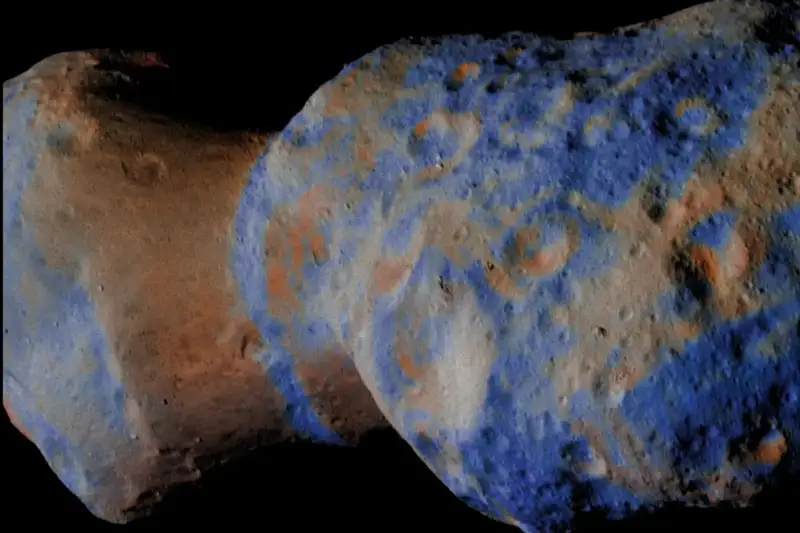
- NASA's Lucy spacecraft encountered asteroid 52246 Donaldjohanson (DJ) in April 2025, providing initial data on its composition.
- Analysis published in *Science* confirms DJ contains iron-bearing phyllosilicate minerals, indicating past interaction with liquid water.
- The presence of water-formed minerals on DJ, located in the inner asteroid belt, challenges theories about where water-rich bodies originally formed in the early solar system.
- Scientists propose DJ likely originated in the outer solar system, later migrating inwards due to gravitational disturbances from gas giants like Jupiter.
Humanity's quest to unravel the cosmic genesis of our home planet has received a significant boost with new findings from NASA's Lucy mission. Preliminary data analysis of the asteroid 52246 Donaldjohanson, affectionately known as DJ, has revealed astonishing insights suggesting that this celestial wanderer may hold vital clues about the very formation of Earth and the mechanisms by which water, fundamental to life, arrived in our corner of the solar system.
Quick summary
- NASA's Lucy spacecraft encountered asteroid 52246 Donaldjohanson (DJ) in April 2025, providing initial data on its composition.
- Analysis published in *Science* confirms DJ contains iron-bearing phyllosilicate minerals, indicating past interaction with liquid water.
- The presence of water-formed minerals on DJ, located in the inner asteroid belt, challenges theories about where water-rich bodies originally formed in the early solar system.
- Scientists propose DJ likely originated in the outer solar system, later migrating inwards due to gravitational disturbances from gas giants like Jupiter.
Why it matters
This discovery transcends mere astronomical curiosity; it carries profound implications for our understanding of planetary science, astrobiology, and the very possibility of life beyond Earth. For decades, scientists have grappled with the 'water problem' – how Earth, forming relatively close to the Sun, acquired the vast quantities of water necessary for oceans and, subsequently, life. Models often point to comets and asteroids from the outer solar system as potential delivery vehicles.
The presence of water-altered minerals on an asteroid currently residing in the inner main belt provides tangible evidence supporting the theory of planetary migration and the transport of volatile materials. If water-bearing bodies like DJ originated far from the Sun and later moved inwards, it suggests that the early solar system was a much more dynamic and interconnected place than previously imagined. This dynamic exchange could have efficiently delivered crucial ingredients, including water and organic molecules, to the inner planets, making them potentially habitable.
For readers, this research redefines our narrative of cosmic origins, suggesting that the building blocks of life might have been widely distributed and transported across vast distances. It fuels the excitement for future missions and observations that could further refine these models, bringing us closer to understanding whether the 'recipe for life' is unique to Earth or a common cosmic occurrence.
Background
The Lucy mission, launched in October 2021, is NASA's first to explore the Trojan asteroids, a large group of primitive asteroids orbiting in two swarms ahead of and behind Jupiter in its orbit around the Sun. These 'fossils of planetary formation' are thought to be remnants from the early solar system, offering direct insights into its primordial composition.
Before reaching its primary targets, Lucy undertook a crucial flyby of asteroid 52246 Donaldjohanson, named after the paleoanthropologist who co-discovered the famous 'Lucy' hominin skeleton. This main belt asteroid, located between Mars and Jupiter, serves as an invaluable precursor target, helping scientists calibrate instruments and gather data from an object less distant than the Trojans.
The prevailing scientific consensus on solar system formation posits a 'frost line' — an invisible boundary beyond which volatile compounds like water ice could condense. Objects forming inside this line were expected to be rocky and dry, while those outside were rich in ice. DJ's current position within the inner main asteroid belt, well inside the expected frost line, presented a scientific puzzle from the outset. The detailed analysis of Lucy's data, particularly its spectral and compositional findings, now begins to unravel this longstanding enigma, building upon decades of telescopic observations and theoretical models about asteroid evolution and migration.

Qnews24h insight
The revelation of phyllosilicate minerals on asteroid DJ, hinting at its watery past, is more than a simple discovery; it represents a compelling piece of evidence challenging and refining our fundamental models of solar system dynamics. For too long, the 'frost line' has been a somewhat static concept in the mental landscape of planetary formation. This data, analyzed by planetary scientist Simone Marchi and his team at the Southwest Research Institute, underscores the dramatic planetary migrations and gravitational perturbations that likely characterized the early solar system.
DJ's bi-lobed shape and its affiliation with the Erigone asteroid family, formed from a colossal collision approximately 155 million years ago, further complicate its narrative. The partial, early water alteration observed in DJ's minerals suggests its history is not straightforward. Whether its formation was late, when radioactive heat sources were depleted, or its birthplace inherently low in water, the critical takeaway is the movement. An object that originated where water was stable, then migrated inwards, provides a tangible mechanism for how the inner planets, including Earth, might have acquired their vital liquid. This dynamic picture of material transport across vast cosmic distances paints a far more interconnected and violent early solar system, one where planetary cores shifted, scattering and delivering critical components, potentially 'seeding' the inner worlds with the prerequisites for life. This ongoing mission promises to deepen our understanding of a truly complex cosmic ballet.
Sources
- soha.vn
- *Science* (research journal where findings were published)
FAQ
What is asteroid 52246 Donaldjohanson (DJ)?
Asteroid 52246 Donaldjohanson, or DJ, is a primitive asteroid located in the inner region of the main asteroid belt, between Mars and Jupiter. It is one of the celestial bodies being studied by NASA's Lucy spacecraft to understand the early history of the solar system.
What significant discovery did the Lucy mission make about DJ?
The Lucy mission discovered that DJ contains iron-bearing phyllosilicate minerals. These minerals are significant because they form in the presence of liquid water, suggesting that the asteroid's parent body once hosted water, despite its current location being too close to the Sun for water-ice to have originally formed there.
How does this discovery impact our understanding of Earth's formation?
The presence of water-formed minerals on DJ supports the hypothesis that water-rich objects may have formed in the colder, outer regions of the solar system and then migrated inwards due to gravitational forces. This mechanism could explain how Earth, which formed closer to the Sun, acquired its abundant water, a crucial ingredient for the development of life.
What are the next steps for the Lucy mission?
Following its flyby of DJ, the Lucy spacecraft will continue its journey to study the Trojan asteroids, which are a group of primitive asteroids orbiting Jupiter. Its next target is 3548 Eurybates, which shares similar spectral and compositional characteristics with DJ, providing further opportunities to gather data on the early solar system.
Why it matters
This discovery transcends mere astronomical curiosity; it carries profound implications for our understanding of planetary science, astrobiology, and the very possibility of life beyond Earth. For decades, scientists have grappled with the 'water problem' – how Earth, forming relatively close to the Sun, acquired the vast quantities of water necessary for oceans and, subsequently, life. The presence of water-altered minerals on an asteroid currently residing in the inner main belt provides tangible evidence supporting the theory of planetary migration and the transport of volatile materials. If water-bearing bodies like DJ originated far from the Sun and later moved inwards, it suggests...
Background
The Lucy mission, launched in October 2021, is NASA's first to explore the Trojan asteroids, a large group of primitive asteroids orbiting in two swarms ahead of and behind Jupiter in its orbit around the Sun. These 'fossils of planetary formation' are thought to be remnants from the early solar system, offering direct insights into its primordial composition. Before reaching its primary targets, Lucy undertook a crucial flyby of asteroid 52246 Donaldjohanson, named after the paleoanthropologist who co-discovered the famous 'Lucy' hominin skeleton. This main belt asteroid, located between Mars and Jupiter, serves as an invaluable precursor target, helping scientists calibrate instruments...
The revelation of phyllosilicate minerals on asteroid DJ, hinting at its watery past, is more than a simple discovery; it represents a compelling piece of evidence challenging and refining our fundamental models of solar system dynamics. For too long, the 'frost line' has been a somewhat static concept in the mental landscape of planetary formation. This data, analyzed by planetary scientist Simone Marchi and his team at the Southwest Research Institute, underscores the dramatic planetary migrations and gravitational perturbations that likely characterized the early solar system. DJ's bi-lobed shape and its affiliation with the Erigone asteroid family, formed from a colossal collision...
References
Editorial information
The editorial team reviews sources, adds context, and structures stories so readers can understand the news more clearly.
Article from QNEWS24H
Comments
(0)No comments yet. Be the first to share your thoughts.