MMO Life Sim Seed Illustrates the Limits of Generative AI Dialogue in Video Games

- Klang Games has launched its persistent MMO colony sim Seed into early access after ten years of development, incorporating generative AI dialogue for its player avatars.
- While initial direct messaging with avatars can produce clever and humorous responses, autonomous conversations between seedlings quickly deteriorate into repetitive, unnatural...
- The title highlights the narrative challenges facing game developers who replace traditional, hand-crafted dialogue trees with unscripted large language models.
For decades, narrative game designers have wrestled with a fundamental limitation: no matter how expansive a virtual world may be, non-player characters inevitably run out of pre-scripted lines to say. The rapid emergence of large language models promised to dismantle this boundary forever, replacing static dialogue trees with living, dynamic conversational agents. However, as developer Klang Games launches its long-awaited MMO colony simulator Seed into early access after nearly a decade of production, real-world player experiences are exposing a persistent paradox. Infinite dialogue does not guarantee meaningful interaction, and low-quality artificial conversation can shatter player immersion faster than a simple scripted line ever could.
Quick summary
- After nearly ten years in development, Klang Games has released Seed into early access, featuring persistent avatars that converse using generative artificial intelligence.
- While individual player prompts can trigger clever, highly context-aware responses, autonomous background interactions between avatars frequently collapse into repetitive, unnatural buzzwords.
- The title highlights an ongoing industry struggle between unscripted, infinite generative AI dialogue and carefully structured, hand-crafted narrative design.
Why it matters
The integration of generative artificial intelligence into interactive entertainment represents one of the most heavily watched technical transitions in modern game development. Game studios hope that AI-driven non-player characters (NPCs) will reduce scripting overhead while providing endless replayability, enabling players to forge entirely personalized narrative journeys. However, Seed serves as an instructive case study for studio executives, narrative leads, and players alike. It demonstrates that superficial linguistic fluency cannot replace dramatic intent, situational logic, or authentic character depth.
For players, the downside of generative chatter becomes obvious during extended gameplay sessions. When artificial dialogue relies on repetitive buzzwords or bizarre adjective choices to fill silence, the illusion of a vibrant world rapidly dissolves into a visible mechanical script. Furthermore, for broader industry observers, Seed underscores that while language models can effectively handle utilitarian tasks—such as answering mechanical gameplay queries—they struggle significantly when tasked with generating believable social atmosphere.
Background
Klang Games first announced Seed nearly a decade ago with the ambitious goal of creating a persistent, player-driven virtual community. Over its long production lifecycle, the title evolved into an intricate MMO colony simulation where player-created avatars, known as "seedlings," inhabit a shared online ecosystem. Notably, these seedlings remain active within the game world even when their human players log off, allowing characters to roam, meet, and interact completely autonomously.
Seed is not the first project to experiment with generative language tools in gaming environments. Over recent years, community modders have plugged external tools like ChatGPT into established single-player role-playing titles, such as The Elder Scrolls V: Skyrim. Those early experimental projects consistently revealed identical vulnerabilities: while AI companions could produce an endless stream of words, they routinely failed simple logic puzzles, lacked spatial awareness, and struggled to maintain thematic consistency. Seed represents one of the first major commercial releases to integrate generative AI conversation directly into its core gameplay engine.
The Seed Experience: Promise and Pitfalls of Generative Speech
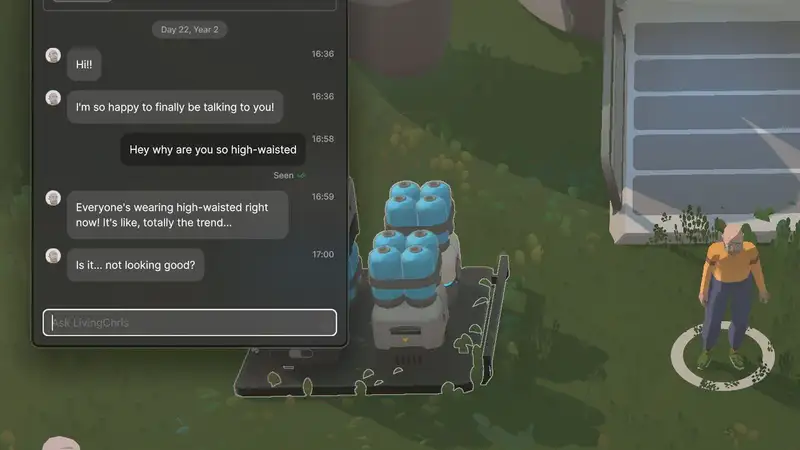
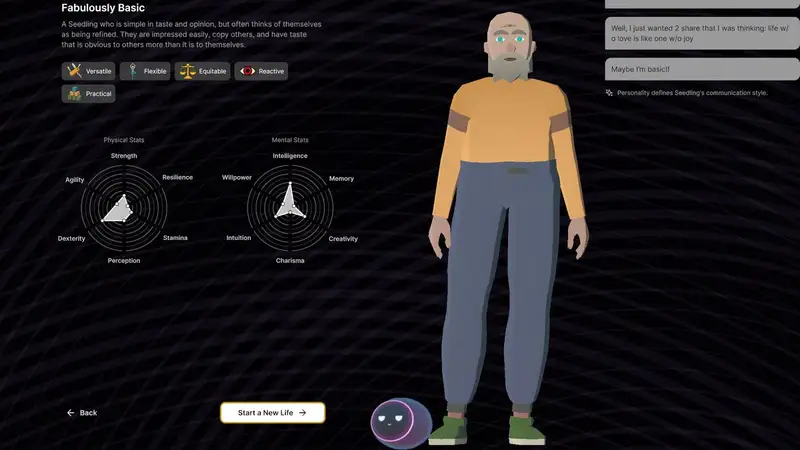
In practice, Seed reveals both the fleeting charm and the rapid fatigue that accompanies generative dialogue systems. When players create a seedling, they select specific personality archetypes. These underlying parameters successfully influence the avatar's tone, generating curt dismissals, overly enthusiastic praise, or persistent gossip. The developer also included subtle UI touches; when a player types a direct question to their avatar, the character visibly pulls out a smartphone to text back.
In isolated instances, this setup produces surprisingly clever interactions. When asked why the avatar's character model featured unusually long legs and short torsos, one seedling wittily defended the design by claiming high-waisted clothing was currently trending. This level of real-time adaptability is impossible within traditional pre-recorded dialogue trees found in conventional life simulators or RPGs.
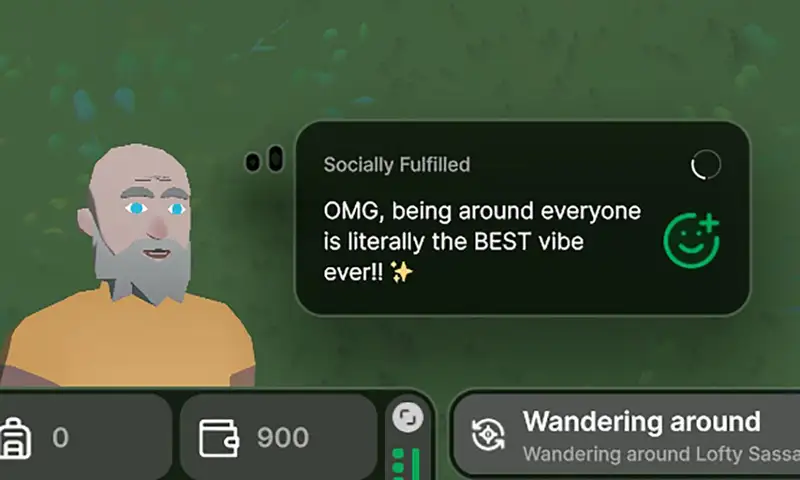
However, the boundaries of the technology become glaringly obvious during unprompted, seedling-to-seedling conversations. Because characters converse persistently in text bubbles without active human direction, the underlying AI relies heavily on synthetic filler to sustain dialogue loops. Avatars repeatedly label ordinary objects, ages, or shoe colors as "heavy," "beautiful," or "iconic," while framing almost every topic as a vague "vibe." Rather than deepening player engagement, these nonsensical exchanges expose the underlying mechanics of a basic chatbot, pulling players out of the fictional world.
Functional Assistance vs. Narrative Immersion
Where Seed's generative system shows genuine promise is in its functional implementation. The game includes an AI-powered tutorial robot capable of processing direct player queries regarding crafting recipes, resource gathering, and game mechanics in plain language. Instead of searching external wikis or reading static manual screens, players can ask specific questions and receive immediate operational advice.
Even within this helper role, however, the system can exhibit inconsistency, occasionally misinterpreting complex commands or delivering vague, unrelated facts. More broadly, it highlights a fundamental divergence in narrative philosophy. Classic life simulation franchises, such as The Sims, achieved long-lasting emotional connection through abstract communication—using thought bubbles, stylized expressions, and symbolic icons. In contrast, Seed attempts full text simulation, exposing the current limits of generative text tools. Where simple symbols stimulate player imagination, endless streams of low-substance AI text risk smothering the world in uninspiring filler.
Qnews24h insight
The early access release of Seed highlights a critical lesson for the future of interactive narrative: infinite output does not equal quality storytelling. Generative language models excel at synthesizing information and mimicking superficial cadence, but they lack intentionality, thematic discipline, and subtext. While generative algorithms will undoubtedly improve as contextual memory windows expand, games that rely on uncurated LLM output risk exhausting players through conversational clutter.
Moving forward, successful narrative design will likely adopt a hybrid framework. Rather than granting total conversational autonomy to language models, studios must deploy AI as a supporting layer over tight, hand-crafted story structures. Until generative models can grasp emotional subtlety and narrative relevance, traditional authorial writing will remain the irreplaceable anchor of video game immersion.
Frequently Asked Questions
What is Seed?
Seed is an MMO colony and life simulation game developed by Klang Games that entered early access after nearly ten years of development. It features persistent player avatars called seedlings who communicate using AI-generated text.
How does AI dialogue function in Seed?
Seedlings use generative AI text bubbles to chat with players and other seedlings in the game world. Players can directly message their avatars, while seedlings also converse autonomously with other seedlings even when players are offline.
Why is AI dialogue in games controversial among players?
While AI dialogue allows for infinite unscripted responses, players often find that autonomous LLM conversations lack genuine meaning, relying on repetitive filler phrases and unnatural word choices that break immersion.
Sources
Original hands-on evaluation and reporting provided by PC Gamer.

























Why it matters
Seed serves as a key real-world testing ground for generative AI in video games, illustrating that infinite text generation cannot replace curated narrative depth or human emotional resonance.
Background
Developing Seed took nearly a decade at Klang Games, aiming to create a persistent world where player avatars exist and interact continuously. It follows earlier community experiments, such as Skyrim companion mods using ChatGPT, which similarly suffered from contextual inconsistency.
Generative AI excels at administrative and utility tasks like in-game tutorials, but relying on uncurated LLMs for core narrative chatter exposes clear technical limits. Developers must balance AI generation with structured human writing to maintain player immersion.
References
Editorial information
The editorial team reviews sources, adds context, and structures stories so readers can understand the news more clearly.
Article from QNEWS24H
Comments
(0)No comments yet. Be the first to share your thoughts.