Mbappé and Haaland Usher in New Era of Football Superstardom
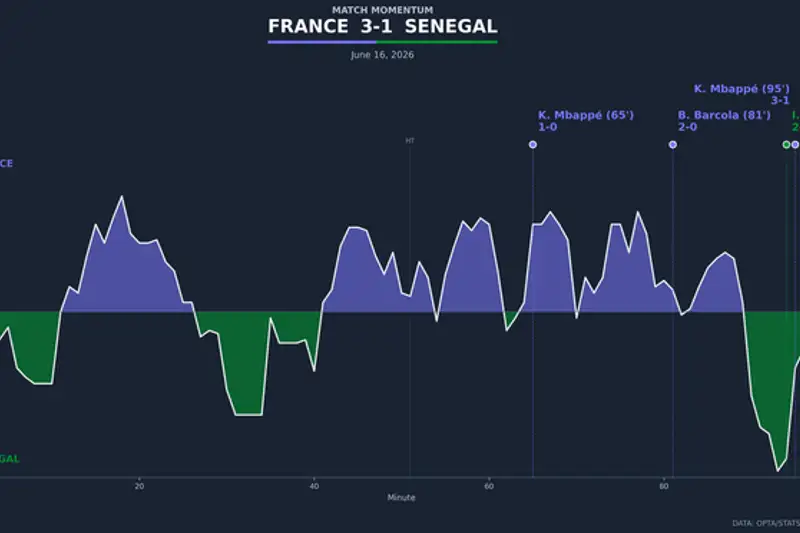
- Kylian Mbappé delivered a match-winning brace for France against Senegal, leading his team to a 3-1 victory after an initial struggle.
- His two goals made him France's all-time leading goalscorer and their top scorer in World Cup history, surpassing national legends.
- Erling Haaland made a dominant World Cup debut for Norway, scoring two goals and forcing an own goal in a 4-1 win over Iraq.
- The performances by Mbappé and Haaland signify a definitive shift to a new era of football superstars post-Messi and Ronaldo.
The world of football holds its breath as two titans of the game, Lionel Messi and Cristiano Ronaldo, approach the twilight of their illustrious careers. Yet, as one chapter closes, another begins, with a new generation of electrifying talent already asserting its dominance on the grandest stages. This World Cup, in particular, has seen a powerful declaration from Kylian Mbappé, whose recent heroics for France have not only secured crucial victories but also firmly cemented his place, alongside Erling Haaland, at the forefront of this emerging era of global superstars.
Quick summary
- Kylian Mbappé delivered a match-winning brace for France against Senegal, leading his team to a 3-1 victory after an initial struggle.
- His two goals made him France's all-time leading goalscorer and their top scorer in World Cup history, surpassing national legends.
- Erling Haaland made a dominant World Cup debut for Norway, scoring two goals and forcing an own goal in a 4-1 win over Iraq.
- The performances by Mbappé and Haaland signify a definitive shift to a new era of football superstars post-Messi and Ronaldo.
Why it matters
This rapid ascent of players like Mbappé and Haaland signals a significant generational changing of the guard in global football. For fans, it means new rivalries, new records, and a fresh wave of iconic moments to anticipate, ensuring the sport's top-tier drama continues unabated.
For clubs and national teams, understanding and harnessing such exceptional individual talent becomes paramount. It influences transfer market strategies, tactical approaches, and the commercial appeal of leagues and tournaments worldwide, potentially reshaping the economic landscape of football.
The era of prolonged two-player dominance is giving way to a potentially more diverse field of contenders for individual accolades like the Ballon d'Or, fostering heightened competition and unpredictable outcomes, which ultimately benefits the sport's global viewership and engagement.
Background
For nearly two decades, the football world has been captivated by the unparalleled rivalry and consistent brilliance of Lionel Messi and Cristiano Ronaldo. Their duopoly over individual awards and their records across club and international football set an incredibly high bar, defining an entire era for countless fans and analysts.
As this World Cup approached, questions lingered about who would step into the void their eventual departures would leave. France, one of the tournament favorites, often exhibits a tendency for slow starts in major competitions, adding an element of early uncertainty to their campaign.
The current tournament, expanded in its format, places increased pressure on top-tier nations to secure early points and manage squad depth, especially in the face of resilient opponents. Senegal, as reigning African champions, presented a formidable challenge, making France's victory, particularly after a difficult first half, a crucial early statement.
Mbappé's Masterclass: Turning the Tide Against Senegal
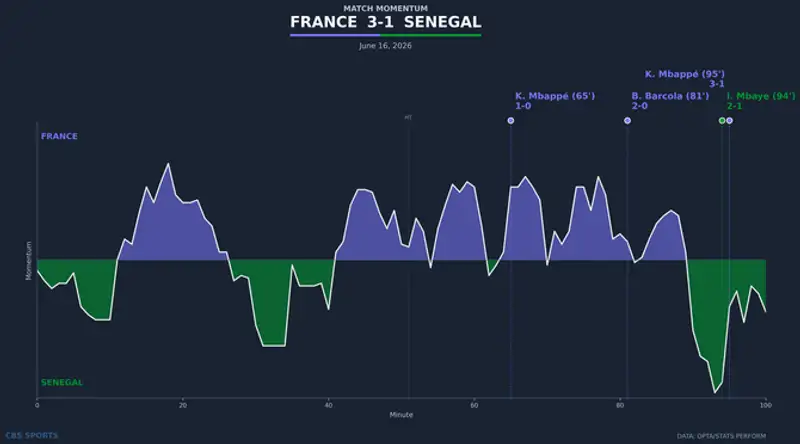
France’s opening World Cup encounter against Senegal, the formidable champions of Africa, proved to be a sterner test than many anticipated. Les Bleus found themselves in an uncharacteristically sputtering rhythm during the first half, managing only a single shot on target. Senegal’s disciplined defense and energetic press effectively stifled the French attack, creating an early sense of anxiety among the tournament favorites.
However, as the second half unfolded, the physical demands of the game began to take their toll on the Senegalese squad. It was precisely at this juncture that Kylian Mbappé, the undisputed talisman of the French side, seized control. Despite what some might consider a sub-par overall performance by his own stratospheric standards, the forward delivered a decisive brace, transforming the match’s trajectory. His ability to impact the game so profoundly, even when not operating at his absolute peak, underscored his extraordinary talent and the sheer breadth of his ceiling.
Historic Milestones Etched in Gold
Mbappé’s dual strikes against Senegal were not merely game-winning goals; they were historic moments that rewrote the French football record books. With his 58th goal for the national team, he surpassed the veteran striker Olivier Giroud to become France’s all-time leading goalscorer, a remarkable feat for a player still in his mid-twenties. This achievement alone would be significant, but Mbappé wasn't finished.
He also ascended to the top of France’s World Cup goalscoring charts, netting his 14th goal in the competition to overtake the legendary Just Fontaine, who famously scored 13 goals in a single tournament in 1958. While surpassing Fontaine's single-tournament record remains a challenge, with France potentially having more games to play en route to the final, the possibility of Mbappé achieving even more extraordinary feats in this tournament remains tantalizingly real, particularly with the support of players like Michael Olise.
Deschamps Defends His Superstar
Despite Mbappé’s undeniable impact, his playing style often attracts scrutiny, particularly concerning his defensive contributions. France manager Didier Deschamps, however, remains steadfast in his defense of his star forward. Following the Senegal match, Deschamps articulated his perspective, stating, "People will still criticize Mbappé. He's an iconic player. He can miss a game or two, but on one action, he can tip the scales."
Deschamps explicitly addressed the defensive criticisms, clarifying Mbappé's role: "People say he doesn't defend enough, but he's not here to defend, and he can do enough of that." The manager also shed light on Mbappé's mental fortitude and ambition, revealing that the player preferred to break goalscoring records in a decisive match rather than a friendly, highlighting his competitive drive. Deschamps' comments reinforce the idea that for a player of Mbappé's unique attacking prowess, occasional defensive lapses are a trade-off worth making for his match-winning capabilities.
The Haaland Horizon: A New Rivalry Ignites
While Mbappé was setting records for France, across different venues, another generational talent was making his emphatic World Cup debut. Erling Haaland, the prolific striker for Manchester City, who had already amassed an astounding 41 goals in all competitions for his club this season, showcased his scoring prowess for Norway against Iraq. Haaland found the back of the net twice in the first half and even forced an own goal, contributing significantly to Norway's commanding 4-1 victory.
Haaland's immediate impact on the global stage, coupled with Mbappé's ongoing brilliance, solidifies their status as the torchbearers of football’s next era. The prospect of these two prodigious talents dominating headlines, challenging records, and potentially competing for individual accolades for years to come has ignited considerable excitement among fans and pundits alike. The presence of other burgeoning talents, such as Lamine Yamal, further underscores the wealth of young prodigies ready to define the sport's future.
Navigating Expectations and Pressure
The path of a global football superstar is invariably paved with immense pressure and constant scrutiny. Mbappé, for instance, has faced a barrage of media attention, including a widely publicized petition regarding his potential move to Real Madrid, despite scoring 43 goals in all competitions this season. His ability to filter out such external noise and deliver impactful performances on the biggest stages speaks volumes about his mental resilience and focus.
Similarly, Haaland’s transition from club success to international impact at the World Cup debut highlights his capacity to meet exceptionally high expectations. Both players are not just performing; they are consistently delivering under the most intense spotlights, a quality that separates true greats from mere talents. Their early World Cup statements serve as a potent reminder that the future of football is not only bright but also firmly in exceptionally skilled hands.
France's Calculated Start and Deep Bench
France’s victory over Senegal, though hard-fought, was a crucial opening statement, especially considering other favored nations like Spain and Brazil had dropped points in their initial matches. Historically, France has often been a team that builds momentum slowly in World Cups, making a full three points from their first game particularly valuable in this expanded tournament format.
Deschamps acknowledged the early difficulties, citing Senegal’s swiftness and compactness, but praised his team's second-half adjustments, particularly with Michael Olise's positioning. The availability of high-caliber substitutes like Bradley Barcola and Rayan Cherki further emphasizes France’s remarkable squad depth. This deep bench ensures that Les Bleus possess an extra gear they can deploy, allowing them to remain formidable even if Mbappé isn't consistently involved in defensive duties. As Deschamps light-heartedly quipped, "If he wants to miss the first half again and score two goals in the second half, that's okay with me."
Qnews24h insight
The early World Cup performances of Kylian Mbappé and Erling Haaland are more than just impressive individual displays; they represent a distinct shift in the very nature of football superstardom. While the Messi-Ronaldo era was characterized by an almost unparalleled statistical consistency across all facets of the game, this new generation, exemplified by Mbappé, is signaling a focus on decisive, game-altering moments, even within performances that might be otherwise "sputtering." Deschamps’ defense of Mbappé’s selective defensive efforts underscores this: for certain generational talents, the sheer ability to tip the scales on a single action outweighs the demand for constant, all-around perfection. This suggests that the definition of a "complete" player at the very top might be evolving, prioritizing singular impact and clutch performance over holistic statistical contribution, creating a more dynamic and arguably more thrilling spectacle.
Sources
FAQ
- Q: What historic records did Kylian Mbappé break?
A: Kylian Mbappé became France's all-time leading goalscorer with 58 goals and their top scorer in World Cup history with 14 goals, surpassing Olivier Giroud and Just Fontaine respectively. - Q: How did Erling Haaland perform in his World Cup debut?
A: Erling Haaland had a dominant World Cup debut for Norway against Iraq, scoring two goals and forcing an own goal in a 4-1 victory, immediately establishing his presence on the global stage. - Q: Why does Didier Deschamps defend Mbappé's playing style?
A: France manager Didier Deschamps defends Mbappé by emphasizing his unique ability to "tip the scales" on one action. He argues that Mbappé's primary role is not defensive but to deliver decisive attacking moments, a trade-off he deems acceptable for the team's success. - Q: What does this mean for the future of global football?
A: The emergence of talents like Mbappé and Haaland signals a definitive generational shift in global football, moving beyond the Messi-Ronaldo era. It promises new rivalries, record-breaking pursuits, and evolving dynamics in top-tier competitions and individual awards.
Why it matters
This rapid ascent of players like Mbappé and Haaland signals a significant generational changing of the guard in global football. For fans, it means new rivalries, new records, and a fresh wave of iconic moments to anticipate, ensuring the sport's top-tier drama continues unabated. For clubs and national teams, understanding and harnessing such exceptional individual talent becomes paramount. It influences transfer market strategies, tactical approaches, and the commercial appeal of leagues and tournaments worldwide, potentially reshaping the economic landscape of football. The era of prolonged two-player dominance is giving way to a potentially more diverse field of contenders for...
Background
For nearly two decades, the football world has been captivated by the unparalleled rivalry and consistent brilliance of Lionel Messi and Cristiano Ronaldo. Their duopoly over individual awards and their records across club and international football set an incredibly high bar, defining an entire era for countless fans and analysts. As this World Cup approached, questions lingered about who would step into the void their eventual departures would leave. France, one of the tournament favorites, often exhibits a tendency for slow starts in major competitions, adding an element of early uncertainty to their campaign. The current tournament, expanded in its format, places increased pressure on...
The early World Cup performances of Kylian Mbappé and Erling Haaland are more than just impressive individual displays; they represent a distinct shift in the very nature of football superstardom. While the Messi-Ronaldo era was characterized by an almost unparalleled statistical consistency across all facets of the game, this new generation, exemplified by Mbappé, is signaling a focus on decisive, game-altering moments, even within performances that might be otherwise "sputtering." Deschamps’ defense of Mbappé’s selective defensive efforts underscores this: for certain generational talents, the sheer ability to tip the scales on a single action outweighs the demand for constant, all-around...
References
Editorial information
The editorial team reviews sources, adds context, and structures stories so readers can understand the news more clearly.
Article from QNEWS24H
Comments
(0)No comments yet. Be the first to share your thoughts.