Marshall Stanmore IV: A Bluetooth Powerhouse Redefining Premium Home Audio

- Marshall Stanmore IV emphasizes a premium, analog audio experience with Bluetooth-only connectivity, eschewing Wi-Fi and smart assistant integration.
- It offers significantly improved sound quality over its predecessor, the Stanmore II, featuring clearer audio, deeper bass, and a wider soundstage.
- The speaker boasts Marshall's iconic, retro design, enhanced physical controls, and a new focus on repairability with replaceable components.
- New Auracast support enables multi-room audio with other compatible Marshall speakers, though not with older models or other brands without additional hardware.
In an era increasingly dominated by smart speakers that blend into the digital ecosystem with Wi-Fi connectivity and AI-powered voice assistants, Marshall’s latest offering, the Stanmore IV, takes a decidedly different path. This speaker is a bold declaration, prioritizing an unadulterated, premium Bluetooth-only audio experience. It’s a strategic move that challenges the conventional wisdom of the modern home audio market, proving that superior sound quality and an iconic design can still captivate discerning listeners without embracing every smart feature trend.
Quick summary
- The Marshall Stanmore IV champions a premium, analog audio experience with exclusive Bluetooth connectivity, opting out of Wi-Fi and smart assistant integration.
- It delivers substantial sound quality enhancements over its predecessor, the Stanmore II, featuring improved clarity, deeper bass, and a more expansive soundstage.
- The speaker retains Marshall's signature vintage design, complemented by refined physical controls and a focus on repairability with interchangeable components.
- New Auracast support facilitates multi-room audio with other compatible, modern Marshall speakers, though it doesn't extend to older models or third-party devices without an additional streaming hub.
Why it matters
The release of the Marshall Stanmore IV is significant because it highlights a growing segment of consumers who prioritize sound fidelity, tangible design, and direct, tactile control over the pervasive integration of smart features and cloud services. In a market where many manufacturers push all-in-one smart hubs, Marshall offers a robust alternative, appealing to audiophiles and design-conscious individuals who desire a streamlined, high-quality audio experience. For the industry, it underscores that a specialized, premium product can still thrive by focusing on core strengths and brand identity rather than chasing every technological fad. Furthermore, its emphasis on repairability speaks to an increasing consumer demand for sustainability and product longevity, a trend that could influence future design and manufacturing practices across consumer electronics.
Background
The Marshall brand carries a rich legacy, deeply ingrained in the history of music as an indispensable amplifier for rock 'n' roll legends. This heritage has been successfully translated into their line of home speakers, with the Stanmore series being a particular standout. The Stanmore II, a popular predecessor, garnered a loyal following for its distinctive sound and classic aesthetic, cementing Marshall's reputation in the home audio space. Simultaneously, the broader audio industry has witnessed a dramatic shift towards Wi-Fi-enabled smart speakers from companies like Sonos, which often integrate voice assistants and a vast array of streaming services, becoming central to the connected home ecosystem.
The Stanmore IV emerges into this landscape not as a direct competitor seeking to mimic these smart features, but as a deliberate evolution of Marshall's core strengths. It builds upon the established success of its forebears, focusing on enhancing audio performance and refining its iconic design, all while consciously resisting the smart speaker trend that has largely defined its market segment. This strategic choice is coupled with an increased emphasis on repairability, reflecting a broader, industry-wide push towards more sustainable and user-serviceable electronics, signaling a thoughtful response to both consumer preferences and environmental concerns.

Qnews24h insight
The Marshall Stanmore IV is more than just an audio device; it represents a powerful statement within the contemporary electronics market. In an environment saturated with increasingly similar smart gadgets, Marshall has chosen to reinforce its distinct brand identity: an unwavering commitment to audio purity, a timeless vintage aesthetic, and the satisfying tactility of physical controls. This deliberate strategic differentiation enables the Stanmore IV to occupy a unique niche, appealing directly to a demographic that values tangible quality and a 'less-is-more' philosophy towards technology. While its exclusive Bluetooth connectivity might be perceived as a limitation by some, it is precisely this focused constraint that defines its allure, positioning it as a premium, simplified sound experience rather than a multi-functional smart hub. Its market presence and positive reception suggest that a strong brand identity and a specialized focus can continue to command a premium, even when a product consciously opts out of prevalent technological trends.
A Classic Aesthetic Meets Modern Craftsmanship
The Stanmore IV proudly wears Marshall’s signature look, featuring a faux-leather exterior, a striking brass speaker grille, and elegant golden accents. This aesthetic is not merely decorative; it ensures the speaker blends seamlessly into diverse home interiors, avoiding the often jarring appearance of many modern gadgets. Unlike its predecessor, the Stanmore II, the Stanmore IV boasts a tidier design with most ports relocated to the speaker's underside. This thoughtful repositioning allows the unit to sit flush against a wall or present a cleaner profile on an open shelf, enhancing its overall integration into a living space. The physical dimensions, 13.78 x 7.99 x 7.28 inches, and an 8.81 lbs weight underscore its status as a mains-powered device designed for a permanent home.
Beyond aesthetics, Marshall has significantly enhanced the user experience with its physical control panel. On the top, three robust knobs allow precise adjustments for volume, treble, and bass, providing satisfying analog feedback often absent in touch-sensitive interfaces. These are complemented by a power switch, a Source button for toggling between RCA, Bluetooth, and Aux inputs, and a playback control button. A new 'M' button adds customizable functionality via the Marshall app, allowing users to switch EQ presets or instantly launch Spotify playlists. The red LED indicators have also been upgraded for improved visibility, further enhancing the speaker's blend of vintage charm and modern usability.
Crucially, the Stanmore IV embraces a more repairable design. Components such as the front grille, control knobs, feet, and the iconic logo are now designed to be swapped out should they incur damage. This move not only extends the speaker's potential lifespan but also aligns with growing consumer demand for sustainable and user-friendly electronics, bolstering confidence in its long-term durability, a sentiment echoed by previous Stanmore models.
Unparalleled Acoustic Performance
The heart of any speaker lies in its sound, and the Stanmore IV delivers profoundly. Compared to the Stanmore II, this latest model offers a distinctly clearer, louder, and more expansive soundstage, enveloping the listener in a rich audio environment. The speaker’s robust architecture includes two 0.75-inch tweeters, each with 25W of amplification, and a powerful 5-inch subwoofer driven by 60W of amplification. This configuration produces a dynamic and well-balanced audio profile, capable of handling a diverse range of musical genres with exceptional fidelity.
The bass response is a particular highlight, delivering a deep, thumping impact without becoming overwhelming or fatiguing to the ears. Lower frequencies maintain clarity and precision, seamlessly integrating with the mid-range. This ensures that even complex rock tracks exhibit excellent instrument separation, allowing individual drum beats and electric guitar riffs to resonate distinctly. Treble frequencies are controlled and vibrant across all volume levels, exhibiting minimal distortion even when the speaker is pushed to its limits. Importantly, this acoustic prowess never compromises vocal clarity, making the Stanmore IV equally adept at rendering the subtle nuances of acoustic performances as it is at the raw energy of rock anthems. While tests with high-resolution codecs like LDAC showed slightly more detailed vocals, the speaker consistently delivered an energetic and tonally accurate performance regardless of the source, indicating a significant leap in its overall sound engineering.
Smart Controls for an Analog Heart
While the Stanmore IV intentionally foregoes Wi-Fi and voice assistants, it integrates a suite of 'smart' features designed to enhance the Bluetooth-centric experience. The dedicated Marshall app serves as a central hub for various customizations and updates. Through the app, users can fine-tune the brightness of the LED indicators, optimize audio output based on the speaker’s placement within a room using 'placement compensation,' and save up to three personalized EQ presets with a five-band equalizer. The previously mentioned 'M' button also finds its utility here, programmable for instant access to these saved EQ settings or direct Spotify playlist initiation via Spotify Tap.
A notable addition to the Stanmore IV, alongside its sibling Acton IV, is Auracast support. This feature finally enables a true multi-room audio experience across compatible new Marshall speakers, allowing users to connect a Stanmore IV with an Acton IV, Woburn, or other supported models. This marks a significant improvement over previous generations, which typically restricted multi-room setups to identical speaker models. However, this enhanced connectivity comes with certain limitations; connecting the Stanmore IV to older Marshall speakers, such as the Stanmore II, or to speakers from other manufacturers, still requires the purchase of a separate Marshall Heddon streaming hub, priced at around $300. This limitation highlights a strategic decision by Marshall to maintain a closed ecosystem for its advanced multi-room features, a point of potential contention for users with mixed audio setups.
Positioning in a Competitive Market
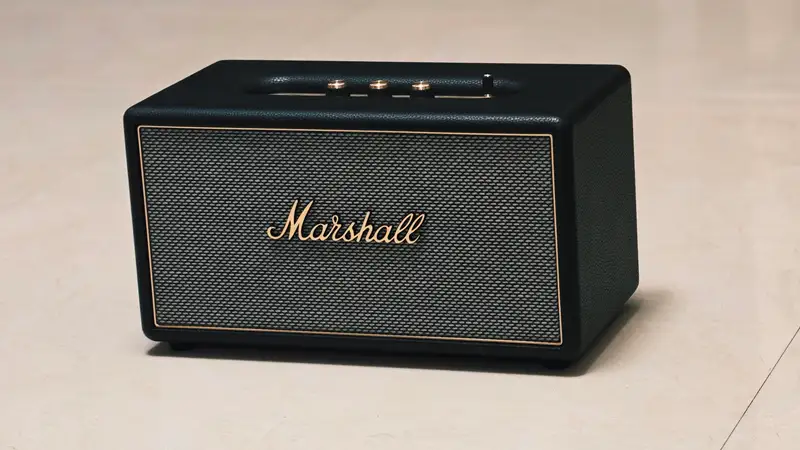
Priced at $430, the Marshall Stanmore IV enters a competitive segment dominated by feature-rich smart speakers. Its closest rival, the $479 Sonos Era 300, for instance, offers Wi-Fi support, integrated voice assistants, and advanced spatial audio capabilities. Yet, the Stanmore IV deliberately sidesteps this direct competition by offering a fundamentally different value proposition. Instead of mirroring the ubiquitous smart features, Marshall doubles down on its strengths: an unmatched blend of iconic design, superior sound quality, and the satisfying tactility of physical controls.
This strategic positioning targets a specific audience—those who prioritize aesthetic appeal, audio fidelity, and durability over extensive smart home integration. For these consumers, the Stanmore IV is not just a speaker; it is a statement piece, an enduring fixture that promises longevity. The introduction of a more repairable design further instills confidence in its long-term value, setting it apart from products often designed with planned obsolescence in mind. Ultimately, for individuals who desire a high-quality, hassle-free audio experience and appreciate a speaker that visually and acoustically enhances their living space without the complexities of a smart hub, the Marshall Stanmore IV emerges as an easy and compelling recommendation in its price range.
Sources
FAQ
Does the Marshall Stanmore IV have Wi-Fi or voice assistant support?
No, the Marshall Stanmore IV is designed as a Bluetooth-only speaker. It intentionally omits Wi-Fi connectivity and built-in voice assistants, focusing instead on a pure, high-fidelity audio experience with a classic, analog-first approach to controls.
What improvements does the Stanmore IV offer over the Stanmore II?
The Stanmore IV provides significant upgrades, including a clearer, louder, and wider soundstage with deeper, non-fatiguing bass. It also features a more repairable design, tidier port placement, enhanced LED indicators, a customizable 'M' button, and new Auracast support for multi-room audio with other compatible Marshall speakers.
Can I connect the Stanmore IV to other Marshall speakers for multi-room audio?
Yes, the Stanmore IV supports Auracast, allowing it to connect with other new Marshall speakers (like the Acton IV or Woburn) for a multi-room audio experience. However, to connect it to older Marshall speakers (like the Stanmore II) or speakers from other brands, a separate Marshall Heddon streaming hub is required.
What is the significance of the Stanmore IV's repairable design?
The repairable design, allowing components like the grille, knobs, feet, and logo to be swapped out, contributes to the speaker's longevity and sustainability. This feature aligns with growing consumer demand for products that are built to last and can be maintained over time, reducing electronic waste and offering greater value.
Why it matters
The release of the Marshall Stanmore IV is significant because it highlights a growing segment of consumers who prioritize sound fidelity, tangible design, and direct, tactile control over the pervasive integration of smart features and cloud services. In a market where many manufacturers push all-in-one smart hubs, Marshall offers a robust alternative, appealing to audiophiles and design-conscious individuals who desire a streamlined, high-quality audio experience. For the industry, it underscores that a specialized, premium product can still thrive by focusing on core strengths and brand identity rather than chasing every technological fad. Furthermore, its emphasis on repairability...
Background
The Marshall brand carries a rich legacy, deeply ingrained in the history of music as an indispensable amplifier for rock 'n' roll legends. This heritage has been successfully translated into their line of home speakers, with the Stanmore series being a particular standout. The Stanmore II, a popular predecessor, garnered a loyal following for its distinctive sound and classic aesthetic, cementing Marshall's reputation in the home audio space. Simultaneously, the broader audio industry has witnessed a dramatic shift towards Wi-Fi-enabled smart speakers from companies like Sonos, which often integrate voice assistants and a vast array of streaming services, becoming central to the connected...
The Marshall Stanmore IV is more than just an audio device; it represents a powerful statement within the contemporary electronics market. In an environment saturated with increasingly similar smart gadgets, Marshall has chosen to reinforce its distinct brand identity: an unwavering commitment to audio purity, a timeless vintage aesthetic, and the satisfying tactility of physical controls. This deliberate strategic differentiation enables the Stanmore IV to occupy a unique niche, appealing directly to a demographic that values tangible quality and a 'less-is-more' philosophy towards technology. While its exclusive Bluetooth connectivity might be perceived as a limitation by some, it is...
References
Editorial information
The editorial team reviews sources, adds context, and structures stories so readers can understand the news more clearly.
Article from QNEWS24H
Comments
(0)No comments yet. Be the first to share your thoughts.