Margiela Tabi Mule: How Avant-Garde Became Everyday Luxury and What It Means for Fashion

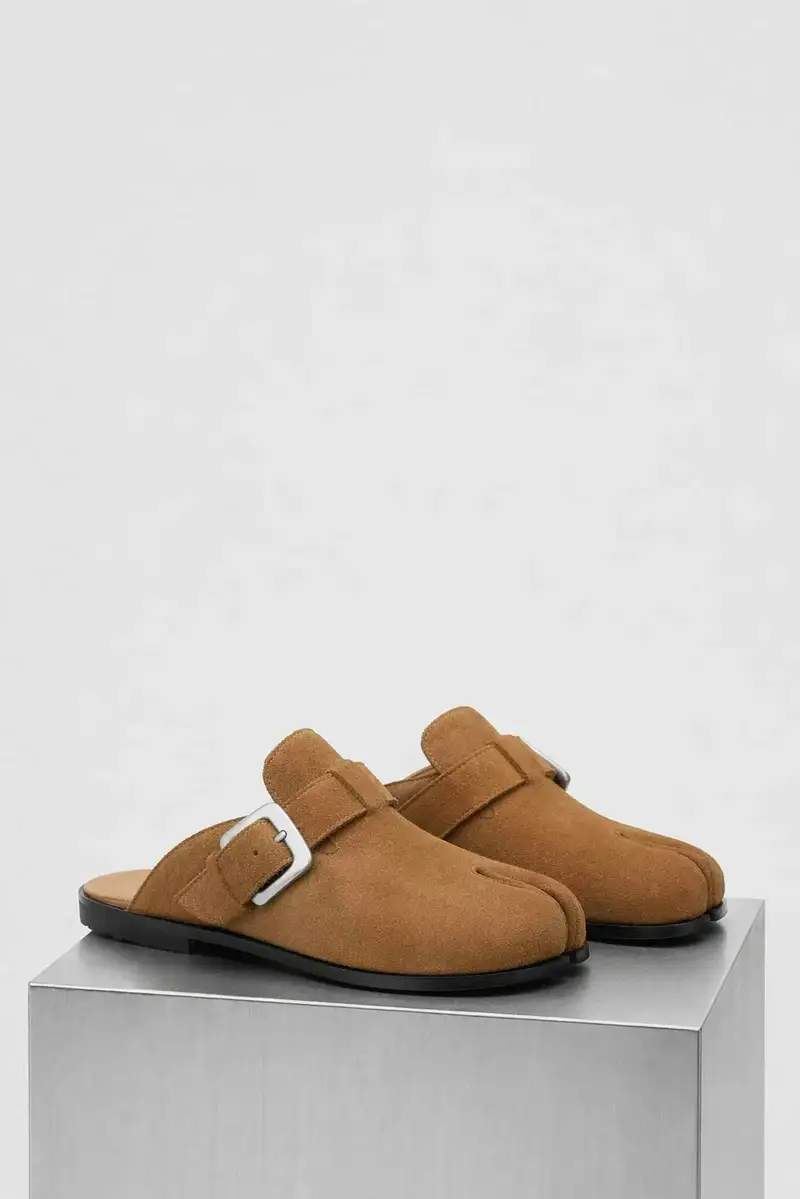
- Maison Margiela has introduced the Tabi Daily Mule, blending its signature split-toe design with a silhouette reminiscent of the widely popular Birkenstock Boston clog.
- This new release reflects a perceived 'normalization' of the Tabi style, transitioning it from a niche, avant-garde statement to a more accessible luxury item.
- Initially shocking in 1989, the Tabi has expanded across various footwear types, with the Daily Mule now offered in suede ($1,290) and polished leather ($1,850) versions.
- The development highlights how high fashion often reinterprets everyday staples, potentially blurring the lines between experimental design and conventional comfort.
The fashion world often thrives on paradoxes, but few are as striking as Maison Margiela’s latest footwear offering: the Tabi Daily Mule. This new iteration marries the brand's unmistakable split-toe design, a symbol of avant-garde rebellion, with the unassuming, comfort-driven silhouette of a Birkenstock Boston. What was once a statement of defiant individuality has seemingly found its way into the realm of the everyday, signaling a profound shift in how luxury fashion interacts with mainstream appeal and challenging the very notion of what constitutes 'weird' in contemporary style.
Quick summary
- Maison Margiela has introduced the Tabi Daily Mule, blending its signature split-toe design with a silhouette reminiscent of the widely popular Birkenstock Boston clog.
- This new release reflects a perceived 'normalization' of the Tabi style, transitioning it from a niche, avant-garde statement to a more accessible luxury item.
- Initially shocking in 1989, the Tabi has expanded across various footwear types, with the Daily Mule now offered in suede ($1,290) and polished leather ($1,850) versions.
- The development highlights how high fashion often reinterprets everyday staples, potentially blurring the lines between experimental design and conventional comfort.
Why it matters
The Tabi Daily Mule's emergence is more than just another shoe release; it's a cultural barometer for the state of luxury fashion. For consumers, it represents a new frontier of 'accessible avant-garde,' where comfort and practicality intersect with high design. This move by a brand as influential as Margiela has significant implications for how other luxury houses might approach integrating their distinctive codes into more ubiquitous forms, potentially diluting their unique selling propositions or, conversely, broadening their market reach. It challenges purists who value the exclusivity and radical nature of experimental fashion, while delighting those who seek a touch of high-fashion irreverence in their daily wardrobe.
For the industry, it signals an ongoing trend where distinct design elements, once reserved for runway shock and editorial spreads, are increasingly assimilated into mass-market luxury. This phenomenon forces brands to continually innovate or risk their most iconic signatures losing their subversive edge. The blending of a distinct high-fashion identity with a universally recognized comfort shoe could redefine what 'luxury' means in an era where comfort and self-expression are paramount, even at premium price points.
Background
The story of the Tabi begins in 1989, when Belgian designer Martin Margiela unveiled his debut collection, famously featuring the cloven-toed boot. Inspired by traditional Japanese tabi socks, worn with thonged footwear like geta and zori, Margiela's creation was revolutionary. It was a provocative, surrealist statement that deliberately challenged conventional notions of beauty and footwear design. The Tabi became an instant icon, a symbol of anti-fashion and intellectual rebellion against the prevailing glamour of the 1980s, establishing Margiela as a formidable force in the avant-garde movement.
For decades, the Tabi remained a distinct, often polarizing piece, cherished by fashion insiders, artists, and those who embraced its subversive aesthetic. Its unique silhouette made it instantly recognizable, a knowing nod among those initiated into Margiela's deconstructionist philosophy. Fast forward to the mid-2010s, and the Tabi's stature as a pinnacle of avant-garde fashion was still strong, evoking a sense of awe and intrigue, especially for newcomers to the high-fashion scene.
In parallel, the Birkenstock Boston clog has carved out its own remarkable trajectory. What began as orthopedic, functional footwear rooted in German health traditions steadily morphed into a widespread casual staple. Its simple, open-back, wide-strap, and suede design became synonymous with comfort and unpretentious style, particularly popular in cities like Berlin where it serves as the ubiquitous summer shoe. The Boston's journey from a utilitarian item to a fashion-conscious casual piece, albeit at a lower price point, represents a different kind of normalization—one based on comfort and universal appeal.
The Tabi Daily Mule now bridges these two disparate worlds. Margiela's decision to adapt the split-toe to a silhouette directly referencing the Boston, and in the process calling it 'Daily,' marks a significant pivot. It suggests an intention to bring this once-challenging design into the realm of everyday wear, following the expansion of the Tabi design into various styles like ballerina flats, slingbacks, pumps, and loafers over the years.
Qnews24h insight
Maison Margiela's introduction of the Tabi Daily Mule should be viewed as a calculated, if controversial, step in the brand's ongoing evolution under creative director John Galliano. While some purists may lament what they perceive as the 'basic-ification' of a truly avant-garde emblem, this move can be interpreted as a strategic effort to broaden the Tabi's appeal, making it more palatable and commercially viable for a wider luxury audience. In an era where comfort reigns supreme and luxury consumers increasingly seek items that blend distinctiveness with practicality, the Tabi Daily Mule taps directly into this demand.
This development underscores a broader trend within the luxury sector: the constant tension between maintaining a brand's challenging, experimental identity and adapting to market realities. By adopting the familiar, comfortable form of a clog, Margiela effectively lowers the barrier to entry for consumers who might appreciate the Tabi's unique aesthetic but find its more traditional boot or pump iterations too radical or impractical. The 'Daily' moniker itself is telling, suggesting a conscious effort to integrate the avant-garde into everyday life, transforming a once-shocking design into an accepted, albeit still distinctive, part of the fashion landscape. The challenge for Margiela, and other similar brands, lies in navigating this path without sacrificing the very essence of the rebellion that defined their initial appeal.
The Normalization of Distinctiveness
The concept of a design moving from radical to commonplace is a recurring theme in fashion history. What was once subversive often becomes assimilated, losing its initial shock value in the process. The Tabi, with its cloven silhouette, was designed to provoke a reaction, to disrupt visual norms. Its initial impact was undeniable, forcing observers to re-evaluate their perceptions of footwear. However, as it proliferates across various styles and now embraces an undeniably 'daily' form, its capacity to truly 'gawk' (as one observer noted) diminishes.
This isn't necessarily a failure of design, but rather a testament to its enduring influence. When an avant-garde concept becomes widely recognized and adapted, it can signify its triumph in shaping aesthetic sensibilities. Yet, it also brings into question the longevity of true distinctiveness within the fast-paced, trend-driven luxury market. Brands must continuously push boundaries, aware that today's radical statement could be tomorrow's everyday staple, especially when comfort and versatility are prized.
Luxury's Embrace of Everyday Aesthetics
High fashion has long had a fascination with elevating the mundane. From designer sneakers to luxury workwear, the industry frequently reinterprets utilitarian objects, imbuing them with opulence and prestige. The Tabi Daily Mule fits squarely within this tradition, but with a unique twist. It's not merely elevating a simple clog; it's fusing it with a design element that has historically symbolized intellectualism and experimentalism.
This fusion reflects a contemporary desire among consumers for luxury items that feel less rigid and more integrated into their lifestyles. The pandemic, in particular, accelerated a shift towards comfort and practicality, even at the highest echelons of fashion. Brands are responding by offering products that, while expensive, feel more approachable and usable in a wider array of contexts than traditional evening wear or highly conceptual pieces. The Tabi Daily Mule perfectly encapsulates this, offering a recognizable luxury signature in a relaxed, comfortable format suitable for urban strolls or casual outings.
Consumer Choices and the Blurring Lines
Today's luxury consumer is sophisticated and discerning, often seeking items that blend status with genuine utility and comfort. The Tabi Daily Mule caters directly to this cohort, offering a distinctive item that carries the weight of Margiela's heritage but in a form factor that resonates with modern, casual dressing. It allows wearers to participate in the 'Margiela mystique' without committing to the more challenging forms of its initial Tabi iterations.
The price points – $1,290 for suede and $1,850 for polished leather – firmly position it within the luxury market, ensuring its exclusivity despite its 'daily' aspiration. This strategy allows Margiela to tap into both the brand's loyal followers who appreciate the evolution of its iconic designs and new customers looking for a statement piece that is both unique and comfortable. The blurring lines between what constitutes avant-garde and what becomes simply 'luxury daily wear' is a defining characteristic of current fashion trends, and the Tabi Daily Mule is a prime example of this ongoing transformation.
Sources
FAQ
- What is the Maison Margiela Tabi Daily Mule?
The Tabi Daily Mule is a new footwear design from Maison Margiela that combines the brand's iconic split-toe (Tabi) silhouette with an open-back, wide-strap, and soft leather upper, reminiscent of a Birkenstock Boston clog. It aims to bring the avant-garde Tabi design into a more casual, everyday context. - What makes the Tabi split-toe design unique?
The Tabi design, first introduced by Martin Margiela in 1989, features a distinctive split between the big toe and the rest of the toes. This design was inspired by traditional Japanese tabi socks and work shoes, and it immediately stood out for its challenging and unconventional aesthetic, becoming a hallmark of avant-garde fashion. - How does the Tabi Daily Mule reflect current fashion trends?
The Tabi Daily Mule reflects several key trends: the ongoing fusion of comfort with luxury, the 'normalization' of once-radical high-fashion designs, and the desire among consumers for distinctive yet practical footwear. It highlights how luxury brands are adapting their iconic elements to suit more casual, everyday lifestyles while maintaining premium pricing.


Why it matters
The Tabi Daily Mule's emergence is more than just another shoe release; it's a cultural barometer for the state of luxury fashion. For consumers, it represents a new frontier of 'accessible avant-garde,' where comfort and practicality intersect with high design. This move by a brand as influential as Margiela has significant implications for how other luxury houses might approach integrating their distinctive codes into more ubiquitous forms, potentially diluting their unique selling propositions or, conversely, broadening their market reach. It challenges purists who value the exclusivity and radical nature of experimental fashion, while delighting those who seek a touch of high-fashion...
Background
The story of the Tabi begins in 1989, when Belgian designer Martin Margiela unveiled his debut collection, famously featuring the cloven-toed boot. Inspired by traditional Japanese tabi socks, worn with thonged footwear like geta and zori, Margiela's creation was revolutionary. It was a provocative, surrealist statement that deliberately challenged conventional notions of beauty and footwear design. The Tabi became an instant icon, a symbol of anti-fashion and intellectual rebellion against the prevailing glamour of the 1980s, establishing Margiela as a formidable force in the avant-garde movement. For decades, the Tabi remained a distinct, often polarizing piece, cherished by fashion...
Maison Margiela's introduction of the Tabi Daily Mule should be viewed as a calculated, if controversial, step in the brand's ongoing evolution under creative director John Galliano. While some purists may lament what they perceive as the 'basic-ification' of a truly avant-garde emblem, this move can be interpreted as a strategic effort to broaden the Tabi's appeal, making it more palatable and commercially viable for a wider luxury audience. In an era where comfort reigns supreme and luxury consumers increasingly seek items that blend distinctiveness with practicality, the Tabi Daily Mule taps directly into this demand. This development underscores a broader trend within the luxury sector:...
References
Editorial information
The editorial team reviews sources, adds context, and structures stories so readers can understand the news more clearly.
Article from QNEWS24H
Comments
(0)No comments yet. Be the first to share your thoughts.