Hyper-Realistic Chinese Bionic Robot Head Sparks Viral 'Uncanny Valley' Debate

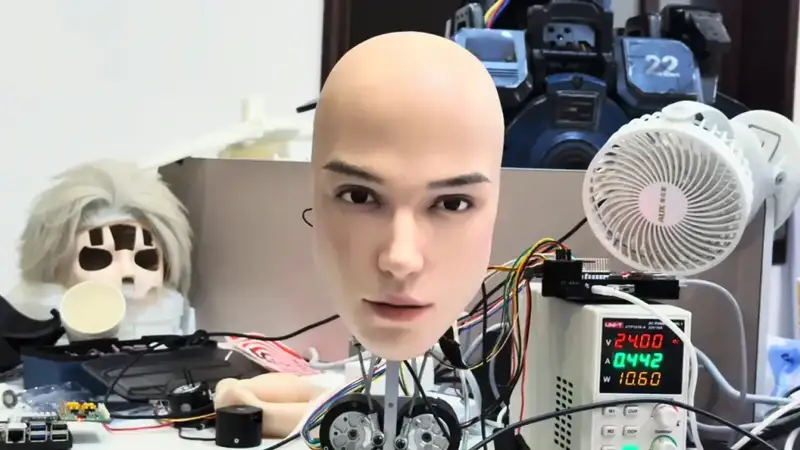
- Shanghai-based Shouxing Technology developed 'Origin F1,' a desktop bionic robot head featuring 26 degrees of freedom in its facial and eye systems.
- The head sparked intense online controversy over the 'uncanny valley' effect due to its realistic skin contrast with slightly stiff head movements.
- Shouxing Technology raised 100 million RMB in Series A2 funding from CITIC Jingshi and Geely Capital to scale mass production and enhance algorithms.
When a Shanghai-based robotics startup unveiled its latest bionic creation online, the intention was to showcase a milestone in human-computer interaction. Instead, the demonstration triggered a visceral wave of unease across social media, reigniting one of robotics' most persistent psychological dilemmas: the uncanny valley effect. Designed as a desktop companion capable of real-world engagement, the device has polarized observers between those who see a historic technological leap and those who find its uncanny lifelike qualities profoundly disturbing.
Quick summary
- Shanghai-based Shouxing Technology developed 'Origin F1,' a desktop bionic robot featuring 26 degrees of freedom across its head, eyes, and facial modules.
- The robot's realistic skin and facial movements triggered intense global debates over the 'uncanny valley,' with critics noting doll-like stiffness while advocates commended its eye contact and blinking mechanisms.
- Shouxing Technology recently closed a 100 million RMB (approx. $14 million) Series A2 funding round co-led by CITIC Jingshi and Geely Capital to scale standardized production and intelligent algorithms.
The Realism Paradox: Crossing into the Uncanny Valley
The term 'uncanny valley'—first coined by Japanese roboticist Masahiro Mori in 1970—describes the sharp dip in human emotional comfort when an artificial figure looks almost, but not entirely, human. As a robot becomes more realistic, human empathy increases up to a point. However, when the appearance is nearly identical to a human yet misses subtle micro-gestures or natural fluidity, the brain registers the entity as eerie or unnatural.
This visual contradiction is at the core of the controversy surrounding Origin F1. While the robot exhibits highly detailed human facial features, viewers noted that its neck and head articulation still retains a rigid, doll-like quality. This contrast between an eerily realistic face and slightly mechanical movement accentuates the awkwardness, leaving many online observers unsettled.
Despite the backlash, proponents within the robotics community argue that these discomforting stages are unavoidable prerequisites for full human-machine integration. Supporters have commended the development team for mastering subtle eye contact and naturalistic blinking patterns, identifying these non-verbal cues as foundational achievements in modern human-robot interaction (HMI).

Engineering Realism: Inside the Origin F1 Tech Stack
Behind the controversial exterior lies a complex mechanical and software architecture designed by Shouxing Technology (also operating in technical documentation as Origin Technology). Origin F1 was conceptualized specifically as a desktop bionic robot tailored for real-world interactive environments, serving as a physical interface for conversational AI and computer vision platforms.
To replicate human expression, engineers equipped the device's head, eye, and facial modules with 26 distinct degrees of freedom (DoF). This high concentration of micro-actuators allows the robot to simulate nuanced facial expressions, pivot its line of sight, and mirror human head movements during active communication.
Multimodal Perception and Interaction
Beyond its physical hardware, Origin F1 relies on an integrated multimodal perception stack that combines visual and acoustic data streams:
- Computer Vision Integration: Supports real-time facial recognition, head tracking, and visual awareness to maintain eye contact with dynamic users.
- Acoustic Processing: Features integrated speech recognition and natural voice synthesis, allowing it to converse in real time without external processing lag.
- Expression Mapping: Uses algorithm-driven synchronization to align facial movements directly with voice output and emotional cues.
Why it matters
The debate surrounding Origin F1 extends far beyond internet sensation—it touches on the commercial viability of next-generation consumer robotics. As artificial intelligence models become increasingly human-like in speech and reasoning, hardware manufacturers are racing to create physical embodiments that match these cognitive capabilities. However, if consumers feel psychologically repelled by hyper-realistic hardware, adoption in consumer sectors like home assistance, elderly care, and customer service could face severe headwinds.
For industries planning to deploy front-facing service robots, the response to Origin F1 highlights a vital design trade-off: is it better to build stylized, explicitly artificial hardware that feels non-threatening, or to push straight through the uncanny valley toward absolute biological replication?
Background
Founded in 2024, Shanghai-based Shouxing Technology has moved rapidly to establish itself in the competitive Chinese hardware landscape. Despite being a relative newcomer, the company recently announced the successful completion of a 100 million RMB (approximately $14 million USD) Series A2 funding round. The investment was co-led by major financial and industrial players, including CITIC Jingshi and Geely Capital.
According to corporate disclosures, this fresh injection of capital will be directed toward three main strategic goals:
- Expanding the company's portfolio of bionic hardware products.
- Establishing standardized, scalable manufacturing assembly lines to lower unit costs.
- Upgrading embedded neural algorithms for real-time natural movement control.
Origin F1 is not the first Chinese robotic innovation to stir public anxiety over extreme realism. Previously, XPeng Motors faced viral skepticism with its humanoid robot, 'IRON.' The fluid motion and detailed construction of IRON were so strikingly life-like that observers openly questioned whether the company had hidden a real human actor inside the suit during public demonstrations.
The Two-Year Horizon: Bridging the Gap
Industry experts argue that public unease toward bionic hardware is a temporary friction point in a rapidly maturing hardware pipeline. Tech analyst Hu Yuhang noted that Shouxing Technology's development path is moving in the right direction, having already survived early proof-of-concept challenges.
Hu projects that within the next two years, advances in high-frequency motor control and generative AI micro-expressions will allow bionic systems to bridge the uncanny valley entirely. Once mechanical stiffness is eliminated, hyper-realistic interfaces are expected to transition smoothly from specialized research labs into daily domestic and commercial life.
Qnews24h insight
The public reaction to Origin F1 reveals a fundamental mismatch between engineering priorities and human perception. While capital markets—backed by powerhouses like Geely and CITIC—are betting heavily on biological replication, end-users remain hyper-sensitive to microscopic visual flaws. Creating 26 degrees of freedom is an impressive mechanical feat, but if motor actuation lags behind human micro-expressions by even a fraction of a second, the visual result triggers defensive psychological reactions.
Robotics developers must realize that crossing the uncanny valley is not merely a matter of hardware specs or facial skin elasticity. It requires absolute synchronicity between cognitive AI responses and fluid muscle simulation. Until motor control algorithms can mirror subconscious human motion perfectly, companies may find broader consumer acceptance by adopting sleek, functional, and non-anthropomorphic designs rather than rushing hyper-realistic biological heads into the market.
Sources
Original report and factual details sourced from Soha.vn and public corporate disclosures from Shouxing Technology.
Why it matters
The controversy highlights the psychological friction tech companies face when designing companion and service robots. If consumer hardware causes unease through the uncanny valley, mass adoption in home care, hospitality, and retail could be significantly delayed regardless of underlying AI capabilities.
Background
Shouxing Technology was established in 2024 and quickly secured major institutional backing. The push toward extreme physical realism follows similar market developments in China, such as XPeng Motors' 'IRON' humanoid robot, which previously sparked online debates over whether it contained a real human performer.
Achieving hyper-realistic physical hardware is a double-edged sword. While investors favor biological anthropomorphism, minor movement delays disrupt human comfort. Hardware manufacturers may achieve faster commercial viability by focusing on fluid, stylized designs rather than pushing hyper-realistic faces before micro-expression actuation matures.
References
Editorial information
The editorial team reviews sources, adds context, and structures stories so readers can understand the news more clearly.
Article from QNEWS24H
Comments
(0)No comments yet. Be the first to share your thoughts.