Elon Musk Nears Trillionaire Status as SpaceX Debuts Historic $75 Billion IPO
- SpaceX launched the largest IPO in history at $135 per share, successfully raising approximately $75 billion in public capital.
- Elon Musk's net worth is poised to breach the $1.1 trillion mark if SpaceX shares rise to $140, though a significant portion of his wealth remains tied to extreme, long-term...
- The IPO is a life-changing event for over 4,400 current and former SpaceX employees who now hold million-dollar stakes, including roughly 400 individuals whose shares exceed $100...
- Pre-IPO disclosures revealed SpaceX has incurred over $13 billion in losses since early 2023, largely driven by aggressive capital allocation toward artificial intelligence and...
On June 12, 2026, the global financial landscape witnessed an unprecedented milestone as SpaceX officially made its debut on the public stock market. Priced at $135 per share, the aerospace giant's initial public offering (IPO) raised a staggering $75 billion, solidifying its place as the largest IPO in corporate history. This massive liquidity event has propelled its enigmatic founder, Elon Musk, to the very brink of becoming the world's first official trillionaire, with a projected net worth climbing toward $1.1 trillion. Yet, beneath the headline-grabbing numbers lies a complex web of performance-tied stock options, massive artificial intelligence expenditures, and a high-stakes gamble on the colonization of Mars.
Quick summary
- Historic Market Debut: SpaceX launched the largest IPO in history at $135 per share, successfully raising approximately $75 billion in public capital.
- The Path to Trillionaire Status: Elon Musk's net worth is poised to breach the $1.1 trillion mark if SpaceX shares rise to $140, though a significant portion of his wealth remains tied to extreme, long-term operational milestones.
- Substantial Employee Wealth: The IPO is a life-changing event for over 4,400 current and former SpaceX employees who now hold million-dollar stakes, including roughly 400 individuals whose shares exceed $100 million.
- Deep Operational Spending: Pre-IPO disclosures revealed SpaceX has incurred over $13 billion in losses since early 2023, largely driven by aggressive capital allocation toward artificial intelligence and deep-space transport technologies.
Why it matters
The public listing of SpaceX is not merely a wealth-generation event for Elon Musk; it represents a paradigm shift in how humanity's transition to a multi-planetary species is funded. By transitioning from a tightly controlled private entity to a public company, SpaceX is subjecting its ambitious interplanetary goals to the quarterly scrutiny of Wall Street. For the broader tech and aerospace industries, this IPO establishes a new valuation benchmark that dwarfs legacy defense contractors and aerospace giants alike.

Furthermore, the creation of thousands of new millionaires among SpaceX's rank-and-file employees will likely trigger a massive wave of secondary investments in the Silicon Valley and Los Angeles tech ecosystems. With roughly 400 employees now holding equity valued at over $100 million, a new class of venture capital and angel investing powerhouses is poised to emerge. Conversely, the concentration of wealth in Musk’s hands—capable of theoretically purchasing entire professional sports leagues like the NBA and NFL, or millions of residential homes—will inevitably reignite global debates regarding wealth inequality and the influence of private individuals over public-domain science and infrastructure.
Background
Before this historic IPO, SpaceX operated for more than two decades as a private juggernaut, relying on private funding rounds, government contracts from NASA, and commercial satellite launch revenues to fund its Starship and Starlink programs. Over the years, the company's valuation swelled as it successfully monopolized the global launch market, leaving traditional aerospace competitors scrambling to keep pace.
However, the journey to public markets has been incredibly capital-intensive. Financial disclosures prepared for the IPO revealed that SpaceX burned through a staggering $13 billion since the beginning of 2023. This massive cash burn was not due to operational inefficiency, but rather a deliberate, aggressive pivot toward integrating advanced artificial intelligence into autonomous spacecraft and manufacturing logistics, alongside the continued development of the massive Starship rocket system. Unlike traditional corporate structures, Musk's compensation at SpaceX—much like his historic package at Tesla—avoids standard salaries in favor of milestone-based equity grants. These packages are structurally tied to highly ambitious, long-term goals, including the deployment of a million humanoid robots at Tesla and the establishment of a self-sustaining human habitat on Mars.
The Trillion-Dollar Threshold
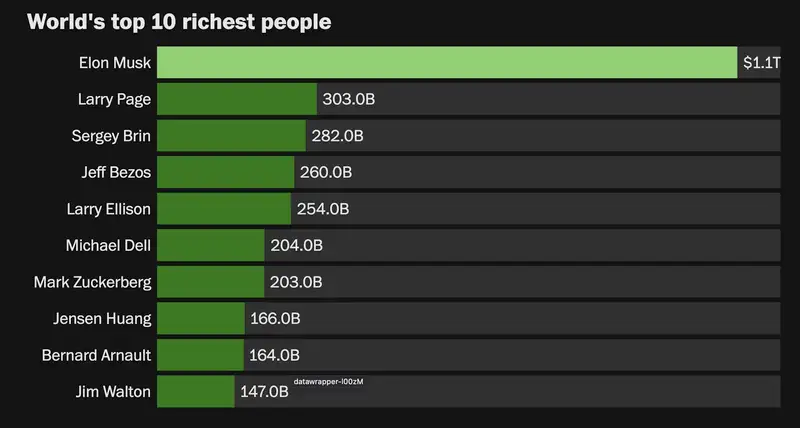
To understand the mechanics of Musk's current net worth, one must separate paper assets from realized wealth. While his total projected assets hover around $1.1 trillion, a substantial portion of this valuation is contingent upon the vesting of performance-based shares. If these milestone-restricted shares are excluded, Musk falls just short of the trillion-dollar mark. However, the public markets may soon resolve this distinction on their own terms. If public trading pushes the newly listed SpaceX stock from its debut price of $135 up to $140 per share, the organic valuation surge will officially crown Musk a trillionaire, independent of his progress on Mars colonization.
Qnews24h insight
From an editorial perspective, SpaceX’s IPO is a double-edged sword that highlights both the triumph of private space enterprise and the volatile nature of speculative tech valuations. Elevating a company to a $75 billion public raise while harboring $13 billion in recent losses is a feat that only a figure like Elon Musk could pull off. This IPO proves that public market investors are no longer valuing SpaceX simply as a rocket launch provider, but rather as an all-encompassing technology frontier play—spanning satellite broadband, planetary defense, defense tech, and advanced robotics.
However, the reliance on performance-tied compensation packages linked to science-fiction-level milestones (such as colonizing Mars) introduces a unique systemic risk. If these ambitious goals prove mathematically or politically unfeasible over the next decade, the potential write-downs or legal disputes over Musk's compensation could trigger unprecedented volatility for retail and institutional investors alike. Furthermore, with reports suggesting internal execution limits could force SpaceX to seek external semiconductor alliances—such as a rumored partnership with MediaTek to bolster its microchip and communication capabilities—the company must prove it can execute its hardware roadmaps without bottlenecking.
Ultimately, the market has bought into the vision of a multi-planetary future. Whether that future can withstand the ruthless, short-term pressures of public quarterly earnings reports remains the most critical question facing the world’s newly minted trillion-dollar empire.
Sources
This report is synthesized from financial disclosures, public IPO filings, and original reporting provided by Znews.vn.
Why it matters
The public listing of SpaceX is not merely a wealth-generation event for Elon Musk; it represents a paradigm shift in how humanity's transition to a multi-planetary species is funded. By transitioning from a tightly controlled private entity to a public company, SpaceX is subjecting its ambitious interplanetary goals to the quarterly scrutiny of Wall Street. For the broader tech and aerospace industries, this IPO establishes a new valuation benchmark that dwarfs legacy defense contractors and aerospace giants alike.
Background
Before this historic IPO, SpaceX operated for more than two decades as a private juggernaut, relying on private funding rounds, government contracts from NASA, and commercial satellite launch revenues to fund its Starship and Starlink programs. Over the years, the company's valuation swelled as it successfully monopolized the global launch market, leaving traditional aerospace competitors scrambling to keep pace. However, the journey to public markets has been incredibly capital-intensive. Financial disclosures prepared for the IPO revealed that SpaceX burned through a staggering $13 billion since the beginning of 2023.
From an editorial perspective, SpaceX’s IPO is a double-edged sword that highlights both the triumph of private space enterprise and the volatile nature of speculative tech valuations. Elevating a company to a $75 billion public raise while harboring $13 billion in recent losses is a feat that only a figure like Elon Musk could pull off. This IPO proves that public market investors are no longer valuing SpaceX simply as a rocket launch provider, but rather as an all-encompassing technology frontier play—spanning satellite broadband, planetary defense, defense tech, and advanced robotics.
References
Editorial information
The editorial team reviews sources, adds context, and structures stories so readers can understand the news more clearly.
Article from QNEWS24H
Comments
(0)No comments yet. Be the first to share your thoughts.