Cosmic Sugar Discovery Hints at Life's Universal Origins

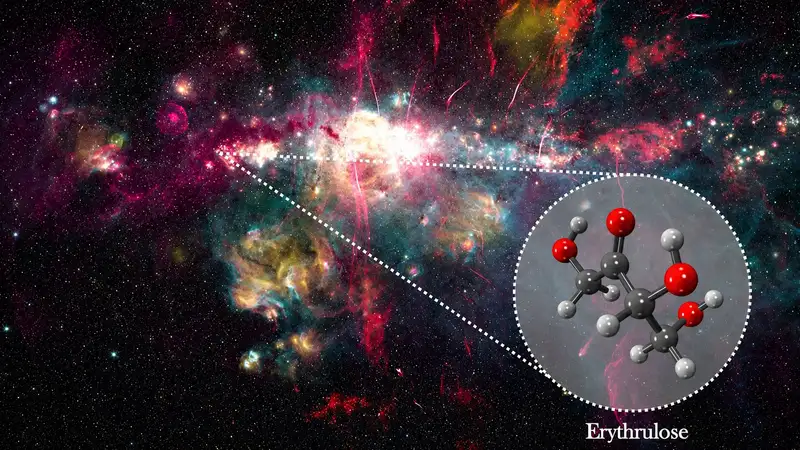
- Scientists have detected erythrulose, a four-carbon sugar, in the interstellar medium near the Galactic Center for the first time.
- This discovery provides compelling evidence that complex organic molecules, crucial for life, can form in space without the need for biological processes.
- The presence of erythrulose supports theories that life's essential chemical precursors, like sugars, could have been delivered to early Earth via comets or asteroids.
- The finding expands the potential for life to emerge elsewhere in the universe, as the building blocks appear to be readily available in various cosmic environments.
The search for the origins of life, a question that has captivated humanity for millennia, has taken a significant leap forward with the unprecedented discovery of a complex sugar molecule in interstellar space. This finding suggests that the fundamental chemical building blocks required for life may form spontaneously and ubiquitously across the universe, long before planets even come into existence.
Quick summary
- Scientists have detected erythrulose, a four-carbon sugar, in the interstellar medium near the Galactic Center for the first time.
- This discovery provides compelling evidence that complex organic molecules, crucial for life, can form in space without the need for biological processes.
- The presence of erythrulose supports theories that life's essential chemical precursors, like sugars, could have been delivered to early Earth via comets or asteroids.
- The finding expands the potential for life to emerge elsewhere in the universe, as the building blocks appear to be readily available in various cosmic environments.
Why it matters
This discovery holds profound implications for our understanding of abiogenesis – the process by which life arises from non-living matter – and the broader field of astrobiology. For decades, scientists have grappled with the mystery of how complex organic molecules, particularly sugars essential for RNA and DNA, came to exist on early Earth. Laboratory experiments attempting to recreate primordial conditions have often struggled to produce these molecules efficiently.
The detection of erythrulose directly in interstellar space offers a powerful new perspective. It suggests that the universe itself might be a vast chemical factory, capable of synthesizing these intricate components within molecular clouds. This shifts the focus from Earth-bound origins to a cosmic genesis, implying that the raw materials for life might not be unique to our planet but rather a common feature of star-forming regions throughout the galaxy. For scientists, it provides tangible evidence to support hypotheses that interstellar chemistry played a crucial role in seeding the early solar system with the necessary ingredients for life.
Beyond the scientific community, this finding resonates deeply with the enduring human fascination with extraterrestrial life. If the foundational molecules for life are abundant in the interstellar medium, it significantly increases the statistical probability of life emerging on countless other planets across the cosmos. It fuels the imagination and reinforces the idea that we might not be alone, making the search for life beyond Earth more compelling than ever.

Background
The quest to understand the origins of life has driven scientific inquiry for centuries. A cornerstone of this endeavor has been the search for organic molecules in space, which are considered the chemical precursors to biological systems. Early experiments, like the famous Miller-Urey experiment in the 1950s, demonstrated that amino acids – the building blocks of proteins – could form under simulated early Earth conditions. However, the formation of more complex sugars, vital for genetic material like RNA and DNA, proved more challenging to replicate in terrestrial settings.
Over the past few decades, astronomers have detected a growing number of complex organic molecules in interstellar clouds, including alcohols, aldehydes, and various nitriles. Significantly, several types of simple sugars, such as glycolaldehyde, have previously been identified in star-forming regions. Furthermore, the analysis of meteorites and comets returning to Earth has revealed the presence of various organic compounds, including some sugars like glucose and ribose. These findings bolstered the 'panspermia' hypothesis, suggesting that life's ingredients, or even life itself, might be transported between celestial bodies.
However, the precise mechanism and location for the formation of these complex molecules remained a subject of intense debate. While simple sugars were known to exist in space, the direct detection of a sugar with the complexity of erythrulose, a four-carbon molecule with a specific structure, represents a qualitative leap. This discovery, led by a team including astrochemical chemist Izaskun Jiménez-Serra from Spain's Astrobiology Center and Brett McGuire from MIT, builds upon years of dedicated efforts to identify these elusive molecules, finally yielding a clear signature in the heart of our galaxy. It fundamentally changes our understanding of the chemical complexity that can arise in the cold, sparse environment of interstellar space, preceding the formation of planets.
Qnews24h insight
The detection of erythrulose in interstellar space is not merely another entry in the catalog of cosmic molecules; it signals a critical shift in the prevailing narrative of abiogenesis. For a long time, the difficulty in synthesizing complex sugars under primordial Earth conditions or in laboratory simulations led many to believe that their formation might require a more nuanced, perhaps even biologically mediated, pathway. This new finding, however, strongly indicates that the universe itself is adept at crafting these intricate molecules within the raw environments of molecular clouds, prior to the existence of any planetary surface.
This insight suggests that when rocky planets like Earth began to form, they were likely showered with a rich assortment of complex organic compounds, including vital sugars, already pre-synthesized in their stellar nurseries. It reinforces the idea of a 'chemical continuum' from the interstellar medium to early planetary environments, significantly reducing the chemical hurdles required for the initial spark of life. The implication for astrobiology is profound: if such foundational components are readily available, the initial steps toward RNA-based life become considerably more probable across the vastness of the cosmos, making the emergence of extraterrestrial life less of a unique occurrence and more of a cosmic inevitability under suitable conditions. The next crucial step, as the researchers highlight, will be the quest for ribose and deoxyribose – the direct building blocks of RNA and DNA – which would provide even stronger evidence for a universally pre-primed chemical environment for life.
Sources

- Znews.vn: Phát hiện mới về sự sống ngoài hành tinh
- Nature Astronomy (implied by content, actual article not linked)
The Search Continues: From Sugars to Genetic Code
While the discovery of erythrulose is a monumental step, it also sets the stage for the next phase of astrobiological exploration. Scientists are now more motivated than ever to search for larger and more complex sugar molecules, particularly ribose and deoxyribose. These five-carbon sugars are the foundational components of RNA (ribonucleic acid) and DNA (deoxyribonucleic acid), the very molecules that carry genetic information in all known life forms.
Finding ribose or deoxyribose in interstellar space would be a truly revolutionary breakthrough, offering direct evidence that the fundamental building blocks of genetic material can form spontaneously in the cosmic environment. This would further bridge the gap between inanimate chemistry and the emergence of biological systems, painting a more complete picture of how life's initial sparks may have ignited across the universe.
Technological Advancements Fueling Discovery

Such intricate discoveries are only possible thanks to advanced astronomical instruments and sophisticated data analysis techniques. Telescopes capable of detecting specific molecular signatures in the faint light emanating from distant cosmic clouds are critical. Spectroscopic analysis allows scientists to identify the unique 'fingerprints' of molecules based on how they absorb and emit light, even across vast distances.
The ongoing development of next-generation observatories and refined computational models will be essential for pushing the boundaries of what can be detected. As our technology improves, so too does our ability to peer into the universe's chemical factories, uncovering more secrets about the pervasive chemistry that may underpin life itself. This constant evolution of scientific tools is a testament to humanity's relentless pursuit of knowledge about our cosmic origins.
FAQ
What is erythrulose and why is its discovery in space significant?
Erythrulose is a four-carbon sugar molecule that is found on Earth, for example, in raspberries. Its discovery in interstellar space is highly significant because it's the first time such a complex sugar has been found outside of a planetary body. This suggests that complex organic molecules, essential building blocks for life, can form spontaneously in cosmic environments, rather than exclusively through biological processes or on early planetary surfaces.
How does this finding relate to the origin of life on Earth?
The discovery supports the hypothesis that essential chemical precursors for life, including sugars, could have been delivered to early Earth from space via meteorites, asteroids, or comets. It provides evidence that these crucial molecules were already present in the interstellar cloud from which our solar system formed, making the early Earth chemically primed for life's emergence.
Does this mean life exists elsewhere in the universe?
While this discovery doesn't directly confirm extraterrestrial life, it significantly increases the probability. If the complex chemical building blocks required for life, like sugars, are abundant and can form naturally in various interstellar environments, then the chances of life emerging on other exoplanets with suitable conditions are considerably higher. It suggests that the chemical foundation for life might be a universal phenomenon.
Why it matters
This discovery holds profound implications for our understanding of abiogenesis – the process by which life arises from non-living matter – and the broader field of astrobiology. For decades, scientists have grappled with the mystery of how complex organic molecules, particularly sugars essential for RNA and DNA, came to exist on early Earth. Laboratory experiments attempting to recreate primordial conditions have often struggled to produce these molecules efficiently. The detection of erythrulose directly in interstellar space offers a powerful new perspective. It suggests that the universe itself might be a vast chemical factory, capable of synthesizing these intricate components within...
Background
The quest to understand the origins of life has driven scientific inquiry for centuries. A cornerstone of this endeavor has been the search for organic molecules in space, which are considered the chemical precursors to biological systems. Early experiments, like the famous Miller-Urey experiment in the 1950s, demonstrated that amino acids – the building blocks of proteins – could form under simulated early Earth conditions. However, the formation of more complex sugars, vital for genetic material like RNA and DNA, proved more challenging to replicate in terrestrial settings. Over the past few decades, astronomers have detected a growing number of complex organic molecules in interstellar...
The detection of erythrulose in interstellar space is not merely another entry in the catalog of cosmic molecules; it signals a critical shift in the prevailing narrative of abiogenesis. For a long time, the difficulty in synthesizing complex sugars under primordial Earth conditions or in laboratory simulations led many to believe that their formation might require a more nuanced, perhaps even biologically mediated, pathway. This new finding, however, strongly indicates that the universe itself is adept at crafting these intricate molecules within the raw environments of molecular clouds, prior to the existence of any planetary surface. This insight suggests that when rocky planets like...
References
- 1.znews.vn
Editorial information
The editorial team reviews sources, adds context, and structures stories so readers can understand the news more clearly.
Article from QNEWS24H
Comments
(0)No comments yet. Be the first to share your thoughts.