China Unveils 'Three-Lane' Fiber Optic Network, Boosting Data for AI Fivefold
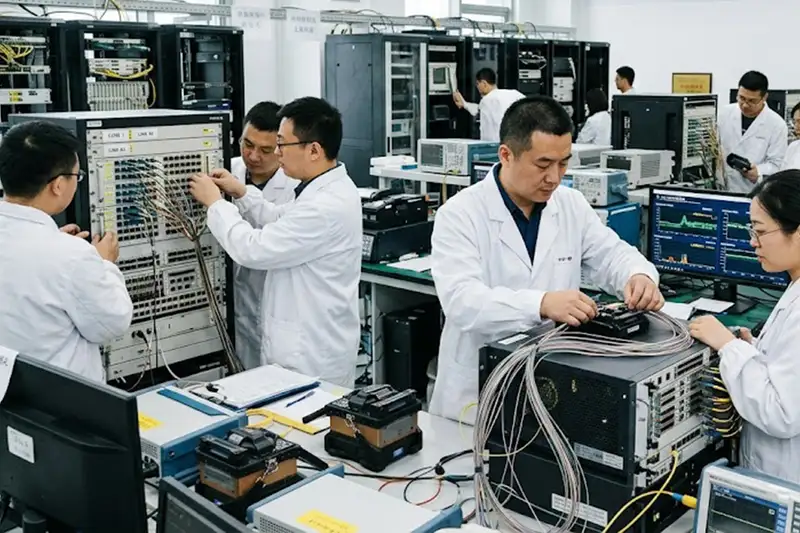
- Chinese researchers have developed a new 'three-lane' optical fiber system capable of boosting data transmission capacity fivefold.
- The technology integrates the S-band with conventional C and L bands, creating a broader 'highway' for light signals, and utilizes advanced four-core fibers.
- It significantly enhances data transfer for AI applications, specifically addressing bottlenecks in GPU cluster communication during large-scale training.
- This system optimizes traffic flow without necessitating the replacement of existing physical fiber optic cables, offering a substantial upgrade to current infrastructure.
In a significant leap forward for global telecommunications infrastructure, Chinese researchers have unveiled an advanced 'three-lane' optical fiber network system poised to revolutionize data transmission. This innovation promises to dramatically increase bandwidth, delivering up to five times the current data traffic capacity, a development particularly crucial for the escalating demands of artificial intelligence workloads and other data-intensive applications worldwide.
Quick summary
- Chinese researchers have developed a new 'three-lane' optical fiber system capable of boosting data transmission capacity fivefold.
- The technology integrates the S-band with conventional C and L bands, creating a broader 'highway' for light signals, and utilizes advanced four-core fibers.
- It significantly enhances data transfer for AI applications, specifically addressing bottlenecks in GPU cluster communication during large-scale training.
- This system optimizes traffic flow without necessitating the replacement of existing physical fiber optic cables, offering a substantial upgrade to current infrastructure.
Why it matters
The relentless expansion of artificial intelligence, cloud computing, and other data-hungry technologies is placing unprecedented strain on existing network infrastructure. Current fiber optic networks, while robust, are nearing their theoretical limits for certain applications, creating bottlenecks that impede progress. This new 'three-lane' system offers a potent solution, providing a much-needed bandwidth injection that could accelerate AI research, enable more sophisticated cloud services, and facilitate the development of future technologies like advanced virtual and augmented reality. For industries relying on real-time data processing and massive data transfer, such as finance, healthcare, and scientific research, this innovation could translate into faster operations, more efficient data analytics, and entirely new capabilities. It also has profound implications for national digital infrastructure, potentially cementing a nation's leadership in the global digital economy.
Background
The foundation of modern internet communication relies heavily on optical fibers, which transmit data as pulses of light. These systems typically utilize specific wavelength ranges, or 'bands,' to carry information simultaneously. For decades, the C-band and L-band have been the workhorses of commercial fiber optic networks, optimized for long-distance transmission and offering high capacities. However, as data traffic has surged exponentially, driven by everything from streaming video to complex machine learning algorithms, the demand for even greater bandwidth has intensified.
One of the primary challenges in expanding capacity has been the difficulty in effectively utilizing other available light spectrums, such as the S-band. While the S-band offers additional capacity, its optical signals tend to attenuate, or weaken, significantly over long distances. This issue has historically made its commercial deployment impractical, as existing optical amplifiers, essential for boosting signals, were not optimized for this particular band. Therefore, while the theoretical potential for more 'lanes' existed, the technical hurdles for their practical implementation remained substantial, leading to a growing gap between network capacity and escalating data demand.
Qnews24h insight
This advancement in optical fiber technology from China represents more than just a technical refinement; it signifies a strategic push in the global race for digital infrastructure dominance, particularly in the context of artificial intelligence. By successfully integrating the S-band and developing multi-core fiber solutions, researchers have effectively expanded the 'digital highway' without requiring a complete overhaul of the physical roadbed. This efficiency in upgrade path offers a significant economic advantage for widespread adoption. The explicit mention of AI applications, specifically the inter-GPU data transfer bottleneck, underscores a clear understanding of the immediate and future needs of high-performance computing. This innovation positions China at the forefront of tackling core infrastructure challenges that are critical for scaling advanced AI models, suggesting a future where data transfer speed, rather than computational power alone, becomes a key differentiator in technological leadership.
Technical Deep Dive: The 'Three-Lane Highway' and Multi-Core Fibers
At the heart of this new system is the concept of a 'three-lane' optical network. Current commercial systems predominantly rely on two lanes: the C-band and the L-band. The Chinese research team has successfully added a third lane, the S-band, to this existing framework. To illustrate, imagine a two-lane highway where traffic is constantly building up. By adding a third lane, the overall flow of vehicles—or in this case, data—can be significantly increased, even if the individual speed limits remain the same.
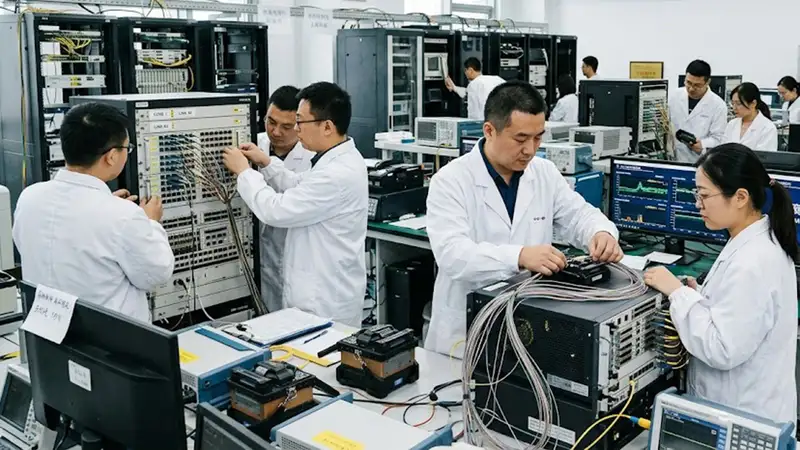
The technical challenge with the S-band has long been its propensity for signal degradation over distance. Standard optical amplifiers, crucial for maintaining signal integrity over long-haul fiber connections, were historically designed and optimized for the C and L bands. The Chinese team's breakthrough involved overcoming these specific engineering hurdles, making the S-band viable for commercial deployment and allowing for its seamless integration alongside the existing C and L bands. This means that data can now be transmitted across a wider range of the light spectrum, enhancing overall capacity without laying new, separate fiber lines.
Beyond Bands: Four-Core Fibers for Unprecedented Throughput
Complementing the expanded light spectrum utilization is another significant innovation: the development of four-core optical fibers. Unlike traditional single-core fibers, which function as a single conduit for light, these new fibers contain four distinct cores. Each of these cores operates independently, effectively multiplying the transmission channels within a single fiber strand. This is akin to having four separate, smaller pipes running parallel within a larger casing, each capable of carrying its own data stream.
The combination of three spectral bands operating across four independent cores within each fiber significantly amplifies the overall data transmission capacity. The researchers claim this design can increase the total traffic capacity by up to five times, while simultaneously boosting the transmission capacity per core by almost 50%. This multi-pronged approach is particularly vital for alleviating data bottlenecks, especially in environments where massive datasets need to be moved quickly and efficiently. For instance, in large-scale AI training clusters, the speed at which data can be transferred between graphics processing units (GPUs) is often a limiting factor in overall training speed. By eliminating these bottlenecks, the new fiber optic network could dramatically accelerate the pace of AI development and deployment.
Global Implications and Future Outlook
This advancement has broad implications beyond AI. The ever-growing demand for higher bandwidth is a universal challenge across the digital landscape. From high-definition streaming and online gaming to the burgeoning Internet of Things (IoT) and the future of smart cities, reliable and ultra-fast data transmission is the bedrock. A fivefold increase in capacity without major infrastructure replacement offers a compelling value proposition for telecommunication providers globally, potentially paving the way for more affordable and widely accessible high-speed internet.
While the immediate focus is on AI, the underlying technology offers a foundational upgrade for all data-intensive applications. It highlights an ongoing trend in telecommunications: pushing the boundaries of existing physical infrastructure through ingenious engineering and spectral optimization. As nations continue to invest heavily in their digital economies, innovations like the 'three-lane' fiber optic network will be critical in shaping the competitive landscape and defining the next generation of global connectivity.
Sources
FAQ
Q1: What is the main innovation of China's new fiber optic network?
A1: The primary innovation is the development of a 'three-lane' optical fiber system that incorporates the S-band spectrum alongside the traditional C and L bands. This, combined with the use of four-core fibers, significantly increases data transmission capacity without requiring new cable installation.
Q2: How much more data can this new network transmit?
A2: The new system is capable of increasing overall data traffic capacity by up to five times, and nearly 50% more transmission capacity per core, compared to existing commercial fiber optic networks.
Q3: Why is this technology particularly important for AI?
A3: Large-scale AI training requires massive amounts of data to be transferred rapidly between GPU clusters. Current networks often create bottlenecks in this process. The new 'three-lane' and four-core fiber technology eliminates these data transfer bottlenecks, significantly accelerating the speed of AI model training and development.
Why it matters
The relentless expansion of artificial intelligence, cloud computing, and other data-hungry technologies is placing unprecedented strain on existing network infrastructure. Current fiber optic networks, while robust, are nearing their theoretical limits for certain applications, creating bottlenecks that impede progress. This new 'three-lane' system offers a potent solution, providing a much-needed bandwidth injection that could accelerate AI research, enable more sophisticated cloud services, and facilitate the development of future technologies like advanced virtual and augmented reality. For industries relying on real-time data processing and massive data transfer, such as finance,...
Background
The foundation of modern internet communication relies heavily on optical fibers, which transmit data as pulses of light. These systems typically utilize specific wavelength ranges, or 'bands,' to carry information simultaneously. For decades, the C-band and L-band have been the workhorses of commercial fiber optic networks, optimized for long-distance transmission and offering high capacities. However, as data traffic has surged exponentially, driven by everything from streaming video to complex machine learning algorithms, the demand for even greater bandwidth has intensified. One of the primary challenges in expanding capacity has been the difficulty in effectively utilizing other...
This advancement in optical fiber technology from China represents more than just a technical refinement; it signifies a strategic push in the global race for digital infrastructure dominance, particularly in the context of artificial intelligence. By successfully integrating the S-band and developing multi-core fiber solutions, researchers have effectively expanded the 'digital highway' without requiring a complete overhaul of the physical roadbed. This efficiency in upgrade path offers a significant economic advantage for widespread adoption. The explicit mention of AI applications, specifically the inter-GPU data transfer bottleneck, underscores a clear understanding of the immediate and...
References
Editorial information
The editorial team reviews sources, adds context, and structures stories so readers can understand the news more clearly.
Article from QNEWS24H
Comments
(0)No comments yet. Be the first to share your thoughts.