China Sets World Record With 11-Kilometer Continuous Subriver High-Speed Rail Tunnel
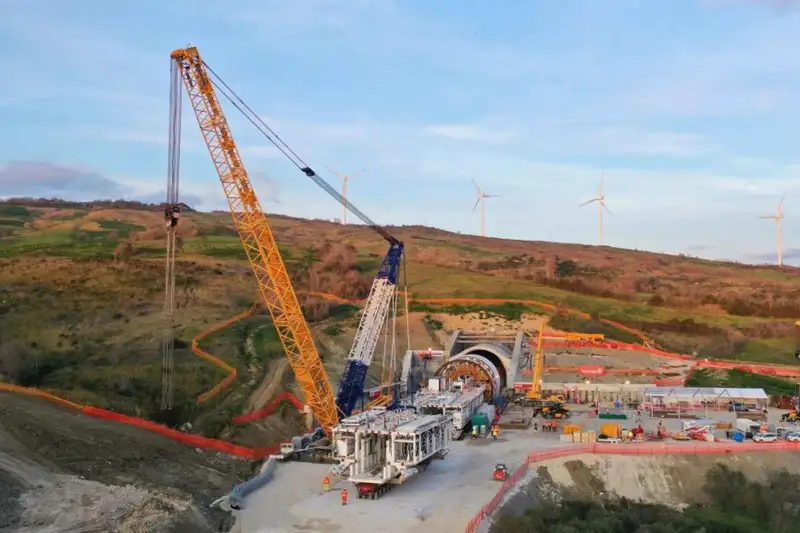
- The custom-built 'Linghang' TBM finished a continuous 11.325 km subriver shield tunnel drive beneath the Yangtze River bed without intermediate shafts.
- The project provides Chongming Island with its first high-speed rail line, cutting travel times to Shanghai Baoshan Station down to just 17 minutes.
- Bullet trains are designed to traverse the subriver tunnel at top operational speeds of 350 km/h, far exceeding underwater velocity limits set in European rail links like the...
- Managed by Shanghai-Hangzhou High-Speed Railway Passenger Transport Co. and constructed by China Railway Tunnel Group, the project forms a core segment of the broader...
Engineering crews in eastern China have established a global benchmark in underground infrastructure construction, completing an uninterrupted 11.325-kilometer shield tunnel drive beneath the bed of the Yangtze River. Driven by a massive, custom-designed tunnel boring machine named 'Linghang' (Navigator), the project paves the way for high-speed trains to dart under the busy waterway at full operational velocity, effectively ending decades of transit isolation for China's third-largest island.
Quick summary
- The custom-built 'Linghang' TBM finished a continuous 11.325 km subriver shield tunnel drive beneath the Yangtze River bed without intermediate shafts.
- The project provides Chongming Island with its first high-speed rail line, cutting travel times to Shanghai Baoshan Station down to just 17 minutes.
- Bullet trains are designed to traverse the subriver tunnel at top operational speeds of 350 km/h, far exceeding underwater velocity limits set in European rail links like the Channel Tunnel.
- Managed by Shanghai-Hangzhou High-Speed Railway Passenger Transport Co. and constructed by China Railway Tunnel Group, the project forms a core segment of the broader Shanghai-Chongqing-Chengdu rail corridor.
Why it matters
Integrating Chongming Island into the national high-speed rail grid represents a significant leap forward in regional urban planning and river-crossing infrastructure. Navigating trains across wide, deep aquatic channels historically meant relying on long bridge Spans vulnerable to harsh maritime weather or building underground tubes that forced trains to decelerate significantly. By constructing a continuous, large-diameter tunnel capable of accommodating dual high-speed tracks at 350 km/h, engineers have eliminated aerodynamic drag hazards while delivering a seamless, weather-proof transit link between Chongming, Taicang, and mainland Shanghai.
Furthermore, the accomplishment validates advanced subsea tunneling methodologies under extreme conditions. The successful drive through soft alluvial silt and shifting sands under heavy water pressure provides an actionable blueprint for upcoming underwater transit megaprojects in coastal regions globally.
Background
By the end of last year, China's national high-speed railway operational network had eclipsed 50,000 kilometers, with central transportation plans calling for an expansion to roughly 60,000 kilometers over the next five years. However, crossing major water barriers like the lower reaches of the Yangtze River has consistently presented severe structural and geological hurdles.
Traditional river-crossing tunnels often required intermediate access shafts to relieve pressure, facilitate ventilation, and allow machine maintenance during lengthy drives. The Chongtai tunnel project bypassed the need for intermediate working shafts entirely, opting instead for a continuous subriver drive across delicate subterranean silt deposits. This structural breakthrough builds upon decades of heavy equipment research and automated geological monitoring, marking a transition from basic underground excavation to precision deep-water shield tunneling.
Qnews24h insight
While completing an 11.3-kilometer uninterrupted subriver drive highlights China's advanced TBM engineering and digital monitoring systems, operating high-speed passenger trains at 350 km/h underground presents complex ongoing operational considerations. Pushing trains through a single-tube enclosure at such velocity generates substantial aerodynamic pressure waves and acoustic compression. Maintaining concrete segment integrity and moisture barriers under 0.9 MPa hydrostatic pressure over decades of continuous vibration demands stringent structural maintenance.
Consequently, the true long-term value of the Chongtai tunnel project lies not merely in breaking construction distance records, but in establishing empirical operational data for high-speed, high-pressure subriver corridors across dense coastal transit networks.
Inside the 'Linghang' Mega Shield Machine
The success of the subriver excavation relied entirely on 'Linghang' (Navigator), a massive tunnel boring machine (TBM) specifically engineered for complex subaqueous geology. Weighing approximately 4,000 tons, the machine features an enormous cutterhead measuring 15.4 meters in diameter, placing it among the largest high-speed rail TBMs ever assembled.
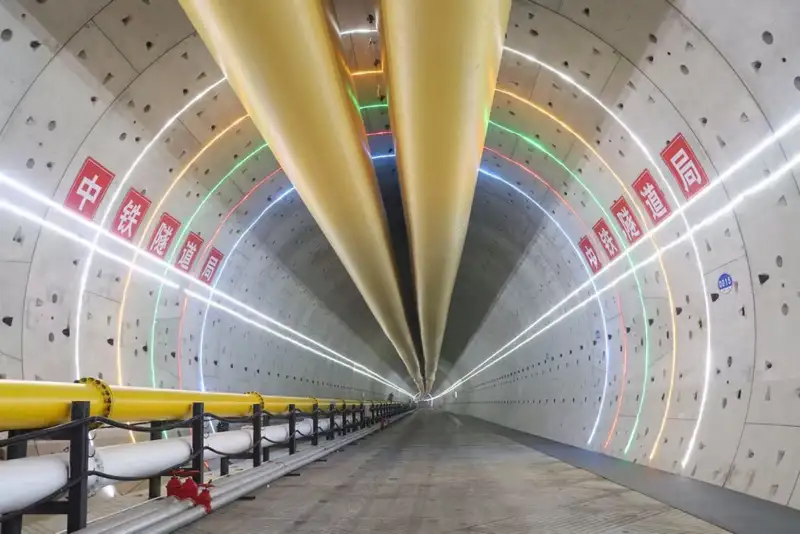
Operating at working depths reaching up to 89 meters below the river surface, Linghang faced water pressures reaching 0.9 MPa. The TBM functioned as a fully integrated mobile factory, excavating silt and sand, clearing debris, stabilizing surrounding soil layers, and installing precast permanent concrete liner segments to form a single-tube tunnel with an outer diameter of 14.8 meters.
To navigate complex underground silt beds without surface guidance shafts, engineers equipped the machine with a digital twin control architecture paired with real-time geological forecasting. This allowed remote operators to monitor cutterhead wear, adjust fluid pressures, and correct directional alignment within millimeter tolerances.
Rewriting Underground Speed Benchmarks
Once operational, the Chongtai tunnel will host bullet trains running at their maximum design speed of 350 km/h beneath the Yangtze bed. This speed profile stands in stark contrast to existing underwater rail structures around the globe.
For comparison, high-speed passenger trains traveling through the Channel Tunnel linking the United Kingdom and France typically limit their underwater operating speeds to around 160 km/h due to aerodynamic resistance and pressure build-up. By designing a wider cross-sectional tunnel geometry, Chinese engineers mitigated the air displacement piston effect, allowing trains to maintain cruising speed without causing severe cabin pressure spikes for passengers.
This technical advancement dramatically compresses regional travel times. Passengers traveling from Chongming Island through Taicang into Shanghai Baoshan Station will see journey times reduced to approximately 17 minutes, effectively integrating the island into Shanghai's suburban commuting radius.
Network Expansion and Strategic Alignment
The tunnel section is being developed under the stewardship of Shanghai-Hangzhou High-Speed Railway Passenger Transport Co., with primary construction managed by China Railway Tunnel Group. It serves as a pivotal bottleneck-clearing link within the strategic Shanghai-Chongqing-Chengdu High-Speed Railway Corridor.
Lessons harvested from the Chongtai excavation are already being applied to next-generation regional transit networks across Guangdong province, the greater Shanghai metropolitan bay region, and other coastal transport belts. As high-speed rail expansion shifts toward challenging aquatic and mountain terrains, continuous large-diameter shield drives are becoming the standard template for high-capacity regional transport infrastructure.
Frequently Asked Questions
What record was set by the Yangtze River tunnel project?
The project established a global record for the longest continuous subriver tunnel drive in its category, completing 11.325 kilometers of non-stop shield excavation beneath the Yangtze River bed without intermediate shafts.
What are the specifications of the 'Linghang' TBM?
The 'Linghang' (Navigator) TBM features a 15.4-meter cutterhead diameter, weighs roughly 4,000 tons, operates at depths up to 89 meters, and withstands water pressures up to 0.9 MPa.
How fast will trains travel through the subriver tunnel?
Bullet trains are designed to pass through the tunnel at top operational speeds of up to 350 km/h without decelerating.
How does this project impact local commuting times?
The line brings high-speed rail service to Chongming Island for the first time, shortening travel time between Chongming (via Taicang) and Shanghai Baoshan Station to 17 minutes.
Sources
- Original reporting and technical data sourced from soha.vn.

Why it matters
Connecting Chongming Island via full-speed subriver transit unlocks major regional integration while demonstrating next-generation tunneling technology capable of handling high water pressure, soft silt, and massive aerodynamic displacement without requiring surface-disrupting intermediate shafts.
Background
China's high-speed rail network crossed the 50,000-kilometer milestone by late 2023, with national planners targeting 60,000 kilometers over the next five-year planning cycle. Historically, crossing major waterways like the Yangtze required long bridges or reduced-speed underwater tunnels. The Chongtai project establishes new engineering benchmarks for long-distance, large-diameter shield drives underneath deep silt layers.
While completing an 11.3-kilometer uninterrupted subriver drive highlights China's advanced TBM engineering and digital monitoring systems, operating high-speed passenger trains at 350 km/h underground presents complex ongoing operational considerations. Pushing trains through a single-tube enclosure at such velocity generates substantial aerodynamic pressure waves and acoustic compression. Maintaining concrete segment integrity and moisture barriers under 0.9 MPa hydrostatic pressure over decades of continuous vibration demands stringent structural maintenance.
References
- 1.soha.vn
Editorial information
The editorial team reviews sources, adds context, and structures stories so readers can understand the news more clearly.
Article from QNEWS24H
Comments
(0)No comments yet. Be the first to share your thoughts.