AI's Memory Thirst Erases Two Decades of RAM Price Reductions in Months

- DDR5 RAM prices have surged to levels last seen in 2007, effectively reversing two decades of market-driven cost reductions.
- The surge is driven by an overwhelming demand for High Bandwidth Memory (HBM) from AI data centers, with AI memory consumption growing 200%+ annually against a 20% production...
- This unprecedented increase is escalating hardware costs across industries including PCs, graphics cards, budget smartphones, and smart automotive manufacturing.
- Industry leaders acknowledge the 'abnormally high' prices and the urgent need to expand memory supply to meet the insatiable AI-driven demand.
A silent yet seismic shift is reshaping the foundations of the global technology market, driven by the relentless ascent of artificial intelligence. In what analysts are calling an unprecedented reversal, the cost of computer memory, specifically RAM, has surged to levels not witnessed in nearly two decades, effectively wiping out 20 years of incremental price reductions in a span of just a few months. This dramatic escalation is a direct consequence of AI's insatiable demand for high-bandwidth memory, creating a supply crunch that reverberates from consumer electronics to enterprise data centers.
Quick summary
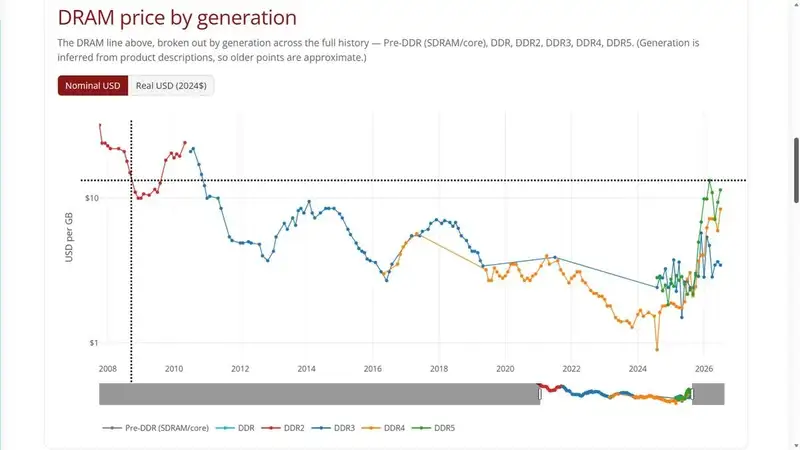
- Current DDR5 RAM prices range from $11.41 to $13.28 per gigabyte, a cost level last observed for DDR2 memory in 2007.
- This price surge effectively negates two decades of cost-saving advancements in memory production, with pre-AI DDR5 memory costing only $2.5-$3/GB.
- The primary driver is the massive demand for High Bandwidth Memory (HBM) from AI data centers, which far outstrips the global memory production growth rate of approximately 20% annually.
- The ripple effects are impacting a wide array of industries, including personal computing, graphics cards, budget smartphones, and smart automotive manufacturing, leading to widespread hardware cost increases.
Why it matters
The dramatic escalation in RAM prices represents more than just a fluctuation in the semiconductor market; it signals a fundamental restructuring of the tech economy's hardware backbone. For consumers, this translates directly into higher prices for new personal computers, laptops, and even smartphones, potentially slowing down upgrade cycles and increasing the cost of entry for new technologies. Gaming enthusiasts will likely face more expensive graphics cards, as these components rely heavily on integrated memory.
Beyond the individual user, the implications for industries are profound. Manufacturers of smart automobiles, which increasingly integrate sophisticated AI systems requiring substantial memory, will see their production costs rise. The budget smartphone segment, already operating on thin margins, faces intense pressure, exemplified by recent price adjustments from major players like Xiaomi. Data center operators, the backbone of the AI revolution, are grappling with exponentially higher infrastructure costs, which could eventually translate to increased service fees for cloud computing and AI-powered applications. This creates a critical bottleneck for AI development and deployment, making advanced computing more expensive and potentially slowing innovation in certain areas.
Background

For roughly two decades, the memory market was characterized by a consistent trend of decreasing prices, driven by technological advancements in manufacturing processes and economies of scale. Each new generation of RAM – from DDR2 to DDR3, DDR4, and most recently DDR5 – brought significant performance improvements alongside lower per-gigabyte costs. Before the recent AI boom, a standard 32 GB DDR5 RAM kit, for instance, could be acquired for approximately $80-95, with per-gigabyte costs hovering around $2.5-$3. This era of affordable memory fueled the expansion of personal computing, enabling more powerful and accessible devices for a global audience.
The landscape began to shift dramatically with the rapid proliferation of advanced AI models, particularly large language models and complex machine learning algorithms. These applications require immense computational power and, crucially, vast amounts of high-speed memory to store and process data efficiently. Traditional DDR5 memory, while fast, proved insufficient for the extreme bandwidth demands of AI accelerators. This led to an explosive demand for High Bandwidth Memory (HBM), a specialized type of RAM that offers significantly greater data transfer speeds and capacity, often integrated directly into AI chips.
The sudden surge in HBM demand, primarily from tech giants building massive AI data centers, created an unforeseen imbalance. While global memory production capacity has seen a healthy growth rate of around 20% annually – a considerable achievement for any industrial sector – it has been utterly overwhelmed by AI's consumption. Elon Musk recently highlighted this disparity, stating that memory demand from AI is escalating at an astounding 200% or more per year. This unprecedented thirst for HBM has diverted manufacturing resources and driven up the cost of all memory components, including standard DDR5, as suppliers struggle to meet the dual pressure of specialized AI needs and broader market requirements. This fundamentally changed a buyer's market into a seller's market for memory, a dramatic reversal of the long-standing trend.
The Unprecedented Price Surge
The data paints a stark picture of this market upheaval. According to the Stanford University's DAM (Dynamic Architecture for Memory) project, current DDR5 memory prices are now fluctuating between $11.41 and $13.28 per gigabyte. To put this into historical context, these figures rival the prices of DDR2 memory back in 2007, when a gigabyte cost between $11 and $15. Adjusting for inflation, today's prices are equivalent to $10.94-$12.74 per gigabyte, bringing costs back to 2011 levels when DDR3 memory was priced around $11.85 per gigabyte.
This rapid appreciation is particularly jarring when contrasted with the immediate pre-AI era, where DDR5 modules were significantly more affordable. The swiftness of this reversal, effectively undoing two decades of manufacturing efficiencies and market competition, underscores the intensity of the demand shock waves emanating from the AI sector. The cost structure for any new hardware development relying on significant memory allocations has been fundamentally altered.
AI's Voracious Appetite for HBM
The core of the problem lies in the distinction between standard RAM and High Bandwidth Memory (HBM). While standard DDR5 memory serves general computing tasks, HBM is specifically engineered for high-performance computing, offering vastly superior throughput essential for training and running complex AI models. These specialized memory modules are produced by a limited number of manufacturers, and the process of increasing their supply is complex and time-consuming.

The demand from AI giants, rapidly building out their computational infrastructure, is effectively cornering the market for these high-end components. This intense competition for HBM not only pushes up its direct price but also strains the overall memory supply chain, as manufacturers prioritize the more lucrative HBM segment, impacting the availability and pricing of other memory types. The Chairman of SK Group, which owns leading chip manufacturer SK Hynix, has publicly acknowledged the 'abnormally high' prices and stressed the industry's urgent need to boost supply.
Ripple Effects Across Industries
The consequences of this memory crisis are far-reaching. Personal computer manufacturers are already facing increased bills for components, which they must either absorb or pass on to consumers. The graphics card market, a significant consumer of high-speed memory, is similarly affected, potentially leading to higher prices for next-generation GPUs. This could dampen enthusiasm in the gaming and professional visualization sectors, where performance-to-price ratios are critical.
The impact is also acutely felt in the smartphone industry, particularly in the competitive budget segment. Devices that rely on cost-effective components are now seeing their core memory become significantly more expensive, making it challenging to maintain attractive price points without compromising on features or profitability. Xiaomi's recent adjustments to phone prices in China are a testament to this pressure. Furthermore, the burgeoning smart automotive industry, with its reliance on advanced embedded systems and AI for features like autonomous driving, is confronting rising hardware costs, potentially slowing the adoption of these innovative technologies.
Beyond Hardware: The Broader AI Landscape
The memory crisis is but one facet of the broader challenges and transformations brought about by artificial intelligence. Discussions around the 'Age of AI' delve into how this technology is fundamentally altering our relationship with knowledge, politics, and society. There are also growing concerns about the practical integration of AI tools, with some reports indicating that poorly implemented AI solutions lead to employee burnout and a longing for pre-AI workflows, due to 'junk AI' that requires extensive error correction.
Conversely, AI is also creating entirely new commercial avenues, such as the emergence of AI-generated short films and 'AI actors' capable of generating significant revenue. These varied impacts illustrate that while AI promises revolutionary advancements, it also presents significant economic, social, and logistical hurdles that the world is only just beginning to confront. The memory price surge is a potent reminder of AI's physical demands and its power to reshape global markets.
Qnews24h insight

The current memory price surge, driven overwhelmingly by AI's demand for HBM, represents a pivotal moment for the technology industry, underscoring the physical constraints underpinning the digital revolution. While a 200% annual increase in demand is unsustainable against a 20% supply growth, the question remains how quickly manufacturers can pivot and scale HBM production. This imbalance will likely persist in the short to medium term, acting as a natural brake on certain aspects of AI expansion by making computational resources prohibitively expensive for smaller players or less critical applications. The broader implications suggest a hardening of the technology landscape, where access to cutting-edge AI infrastructure becomes more consolidated among a few well-funded giants. Consumers and ancillary industries will likely bear the brunt of these increased costs, forcing a reassessment of value propositions across the entire hardware ecosystem. The era of cheap, abundant memory, it seems, has ended abruptly, paving the way for a more stratified and costly future for advanced computing.
Sources
FAQ
Q1: Why are RAM prices increasing so dramatically?
A1: RAM prices are skyrocketing primarily due to the explosion in demand for High Bandwidth Memory (HBM) driven by artificial intelligence (AI) applications. AI data centers require immense amounts of high-speed memory, far exceeding the global supply growth, which is causing a severe supply-demand imbalance across the entire memory market, impacting standard RAM as well.
Q2: What is the difference between standard RAM (DDR5) and High Bandwidth Memory (HBM)?
A2: Standard RAM (like DDR5) is a general-purpose memory used in everyday computers, offering good speed and capacity. HBM is a specialized type of memory designed for high-performance computing, such as AI accelerators and GPUs. It offers significantly higher data transfer speeds and is often stacked vertically with processors to reduce latency, making it ideal for the intense computational demands of AI.
Q3: Which industries are most affected by the rising memory costs?
A3: The rising memory costs are impacting a wide range of industries. These include personal computing (laptops, desktops), graphics card manufacturing, the budget smartphone market (as exemplified by Xiaomi's price adjustments), and the smart automotive industry, which relies heavily on advanced embedded AI systems. Data center operators building AI infrastructure are also facing significantly higher component costs.
Q4: How long are these high RAM prices expected to last?
A4: Industry experts suggest that the current supply-demand imbalance, especially for HBM, will likely persist in the short to medium term. Increasing HBM production is a complex and capital-intensive process that takes time. Until supply can catch up with the exponentially growing AI demand, prices are expected to remain elevated, potentially for several quarters or even longer.
Why it matters
The dramatic escalation in RAM prices represents more than just a fluctuation in the semiconductor market; it signals a fundamental restructuring of the tech economy's hardware backbone. For consumers, this translates directly into higher prices for new personal computers, laptops, and even smartphones, potentially slowing down upgrade cycles and increasing the cost of entry for new technologies. Gaming enthusiasts will likely face more expensive graphics cards, as these components rely heavily on integrated memory. Beyond the individual user, the implications for industries are profound. Manufacturers of smart automobiles, which increasingly integrate sophisticated AI systems requiring...
Background
For roughly two decades, the memory market was characterized by a consistent trend of decreasing prices, driven by technological advancements in manufacturing processes and economies of scale. Each new generation of RAM – from DDR2 to DDR3, DDR4, and most recently DDR5 – brought significant performance improvements alongside lower per-gigabyte costs. Before the recent AI boom, a standard 32 GB DDR5 RAM kit, for instance, could be acquired for approximately $80-95, with per-gigabyte costs hovering around $2.5-$3. This era of affordable memory fueled the expansion of personal computing, enabling more powerful and accessible devices for a global audience. The landscape began to shift...
The current memory price surge, driven overwhelmingly by AI's demand for HBM, represents a pivotal moment for the technology industry, underscoring the physical constraints underpinning the digital revolution. While a 200% annual increase in demand is unsustainable against a 20% supply growth, the question remains how quickly manufacturers can pivot and scale HBM production. This imbalance will likely persist in the short to medium term, acting as a natural brake on certain aspects of AI expansion by making computational resources prohibitively expensive for smaller players or less critical applications. The broader implications suggest a hardening of the technology landscape, where access...
References
Editorial information
The editorial team reviews sources, adds context, and structures stories so readers can understand the news more clearly.
Article from QNEWS24H
Comments
(0)No comments yet. Be the first to share your thoughts.